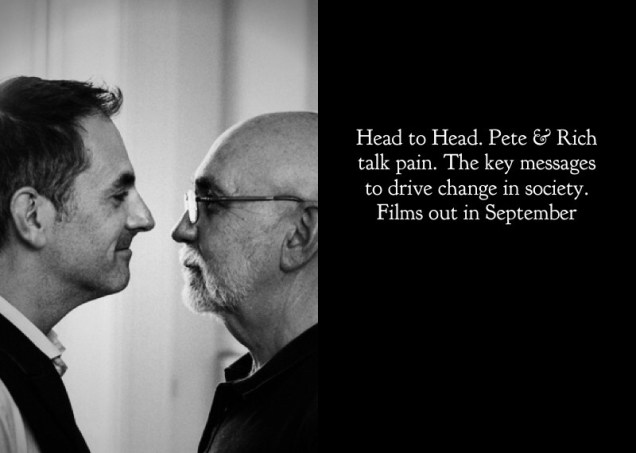
Talking pain with Pete

Pain Coach + Pain Toolkit getting together to deliver the RIGHT messages about chronic pain

This is the first of a series of conversations about pain. Pete’s 5 question challenge:

  • how did you get into pain?
  • what about people looking for a quick fix?
  • what questions should patients ask me?
  • is social media useful?
  • what is the future for pain management?

A series of chats coming soon. Enjoy!

Pain in Spain

Screen Shot 2018-03-12 at 21.45.54
Keynote at the Congreso Fisio 2018

IX UMH Physiotherapy Congress 2018, Alicante

There were several remarkable things about the UMH Physiotherapy Congress in Alicante last week, which I will share below. Before though, I want to state that without doubt, the organisers created a meeting that universities around the globe should seek to emulate. This was a conference that was professionally co-ordinated, filled to the brim with great and varied content, smoothly run, and was attended by an enthusiastic, passionate, sizeable group of 420 professionals and students. The success emerged from the co-ordinated efforts of many individuals, in particular Sergio Hernández Sánchez, Ellana Mckerrell and Roser Bel-lan Roldán.

I was delighted to be asked to speak to over 400 people at the main conference and then run a Pain Coach Workshop for professionals. This was an opportunity to share some of the latest thinking about the global problem of pain, and ideas about how we can go about driving social change together. On reviewing the statistics, it appears that the chronic pain numbers are slightly lower in Spain compared to the rest of Europe (16.6% and 20% respectively). Despite the mild difference, this still represents a major public health issue that needs urgent attention, with the costs estimated at 1.5% of GDP.

“The pain in Spain is mainly on the plain”

This was a conference of the highest quality. The topics, the speakers, the logistics, and the atmosphere were second to none. And what is so remarkable is that the conference was planned, organised and run by the physiotherapy students from UMH. This was as professional as it could be, and therefore the Congreso was a great success as far as I was concerned.

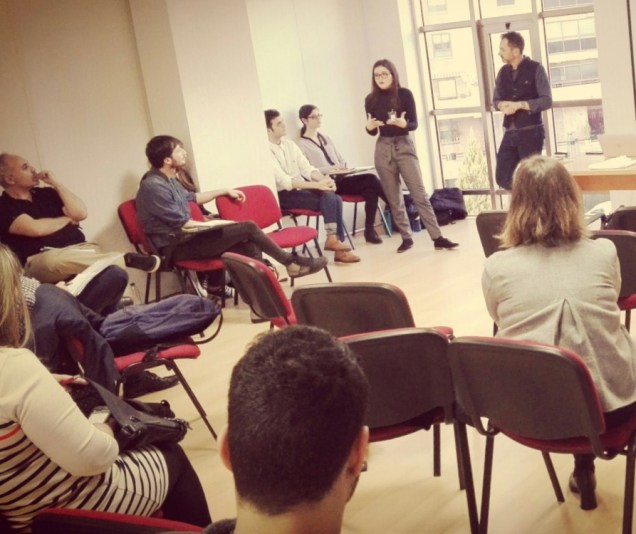
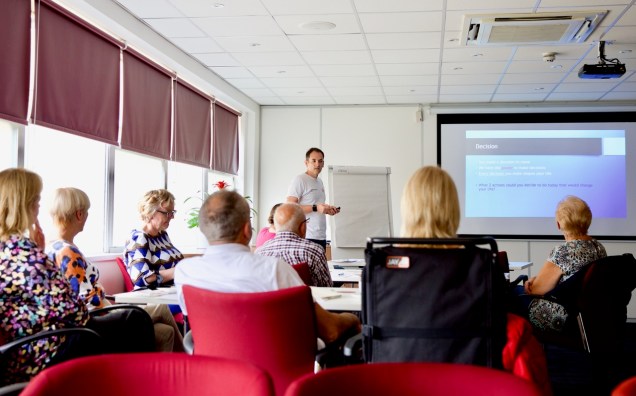
The Pain Coach Workshop was an UP (Understand Pain Social Enterprise) offering, allowing me to work with twenty five professionals who were keen to build on their knowledge and skills for chronic pain. The participants kindly shared their experiences and insights about chronic pain in Spain, and together we worked through a ‘lite’ version of the Pain Coach day.

IMG_1460
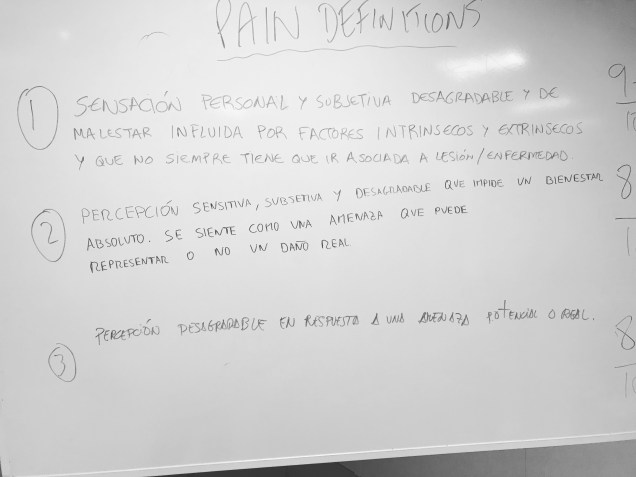
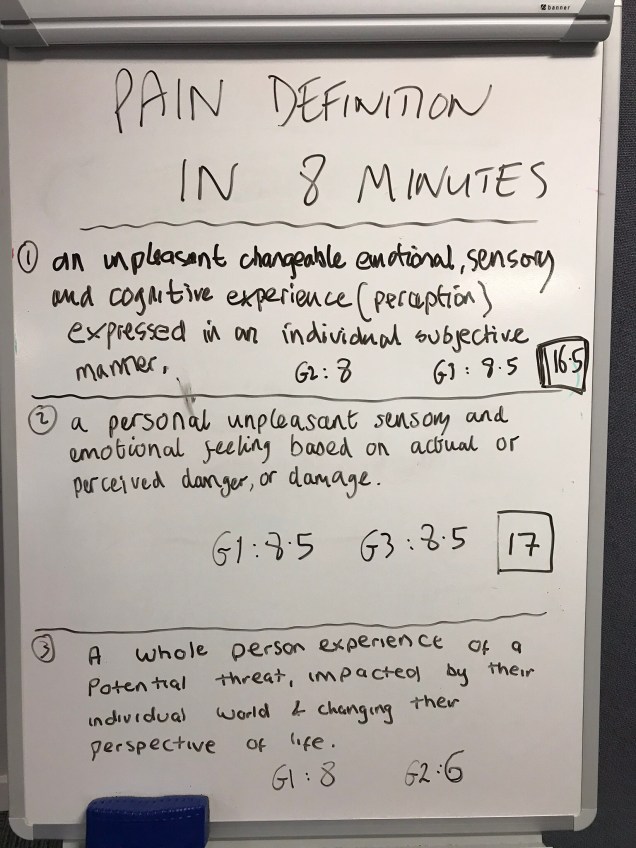
Pain definitions from the 5 minute challenge

With a handful of English speakers, we had a fantastic translation team, who really made the workshop happen. They were brilliant as we got into the rhythm of exchanges. In the three hours we looked at the vehicle of coaching as a means to deliver skills and knowledge, together with always seeking to get the best from both the individual and the clinician. From there, we considered a range of practices including those that seek to build wellness, address sensorimotor adaptations, reduce threat and sensitivity and to encourage people to live their best lives, whatever their circumstances. The emphasis of the Pain Coach is upon realising the choices we have in life and how we make the best ones to achieve success and results. The philosophy that runs through the programme is based upon knowledge, wisdom, and compassion.

6fa12bda-8b56-42b8-a9b4-ea560ccf5359
Translation in action at The Pain Coach Workshop

This was an important trip for several reasons. Firstly to make new friends in Spain so that we can build upon the successes and create future events that benefit individuals and society. Secondly, we have identified a need that we can meet together with education, encouragement and enablement at both the undergraduate and professional levels. And thirdly, we can tap into the passion that was so clearly expressed in the opening ceremony by Roser and Sergio, to move forwards in a positive and productive way.

Screen Shot 2018-03-13 at 10.30.04


For information about keynotes and Pain Coach Workshops, please contact us: painphysiolondon@gmail.com

A story of learning

Funny colorful signpost to different countries around the world

This patient wanted to share her story to inspire others. She travelled to London from her country in Africa to find answers to her pain problem.

Overcoming a pain problem requires understanding that informs practices you use each day, through the day, whilst living life the best way you can. In other words, you may have parameters to work to right now, but these will grow as you develop and build wellness, together with the specific exercises and strategies you use to get better. It is a learning process. Nothing happens in isolation as we are all on a timeline with what is happening now impacting upon the next moment and so on.

Many people do not realise or actualise their potential. We have much more ‘say’ in what happens than is commonly thought. Understanding, awareness, patience and compassion are all key ingredients for gathering insight into what is really happening now, the best actions to take and how to carve out a way onwards that is meaningful.

This is the work of overcoming pain by addressing the needs in ourselves and our lives concurrent with building wellness (resilience, outlook, attention and generosity).

Here are her words:

Hi everyone, my story begun in October 2016. I woke up one morning partially ready to go to work and I noticed a slight pain in my butt, I thought nothing of it and went to work. The next day I was limping but I still ignored the pain because I had a lot of things to take care of at work. What would they do without me in the office? duh… absolutely nothing. The pain kept increasing and within a week I was paralyzed by pain and completely immobile. The pain was so severe in my left leg that moving any other part of my body (eyes and mouth excluded) caused excruciating pain, so I had to lie still. I still get emotional thinking about the day I was taken to the hospital, because the pain was so bad I had several blank moments I fought against because I didn’t want to faint and cause more injury. It was tough but we made it to the hospital eventually.

At first the doctors thought I was suffering sciatica but after a couple of days they saw that the medication did absolutely nothing for me except put me to sleep for long hours. So, I started a series of tests, blood tests, scans, x-rays and MRI all of which were very traumatizing because of the pain and the village it took to help me from one point to the other. Eventually I was diagnosed with transverse myelitis. It was a probable diagnosis, they still weren’t sure.

In the beginning of this whole situation I thought it was something that a pill and a day of rest would cure but as time went by and the pain kept increasing I thought death had come for me. yes, I did feel as if I was going to die but I wasn’t ready so I found myself soliloquizing continuously about my dreams and how I was looking forward to the future. I even remember getting upset for a moment at God for giving me all these dreams and then letting death stand in my doorway before I achieved any of those dreams. A whole day of both internal and external positive speech got me to the point of utter believe that no matter what happened I was going to live.

Weeks passed, the pain was more manageable but I was still bed ridden. For someone who is independent and very private; it was quite devastating to lean on people for every single thing. I mean I am extremely grateful for my mother, she was there from the beginning to the end but it was gut wrenching when I couldn’t sit on my own because my back muscles couldn’t hold me up, so I had to be held like a child or when I couldn’t even brush my teeth or feed myself or lay on the bed myself or bathe myself.  Like I said before, I am extremely grateful for everyone that took care of me but it did not change the fact that it was extremely difficult to see myself in that position; but as time went on I learned to see all the little things we all take for granted when we have complete health and accepting help became easier for me but not without the overflow of gratitude for all other things good. Indeed I learnt to be grateful for everything no matter how little, which was very important in my recovery journey.

Four months passed, I was better and using a walker to get around. I was discharged from the hospital but things did not progress further. I almost panicked wondering if I was ever going to walk on my own again but I didn’t allow myself enter that rabbit hole. Eventually my parents brought me to London for further medical treatment, to see if there was anything the doctors back home missed and after another round of tests and scans I was directed to a Rheumatologist and a Physiotherapists (Richmond Stace).

During my first meeting with Richmond Stace I quickly understood that this was not a physical fight; it was more mental than physical. “The fact that there is pain doesn’t mean that there is injury” he said, these words changed my life because from then on I started to try myself. I developed the courage to believe I could not just walk again but run and dance and do everything I loved to do before I became ill. Some days where extremely harder than others but my self- speech helped me through those days. If I had an emotional issue I could not overcome on my own, I spoke to Richmond about it and he would tell me what to do; it made me understand that I didn’t always have to internalize everything but since I’m the kind of person who doesn’t really like talking to others about my innermost thoughts I found a way that always helps and that is journaling. I don’t write every day but I write when I am battling something that won’t just go away; and it helps every single time.

The days went by, I kept doing my exercises and mental imaging, some days I would think I was getting better and others made it look as if I was going back to square one. I read a lot, everything I read was kind of like an expansion of the things that Richmond was teaching me and it was a wonderful blend. The time for us to go back home was near and I was able to take at most five painful steps a day. I remember the day my mother booked our tickets back home, she requested for assistance and it upset me so much because it made me feel as if I was not going to get better before we go back. I was going to go back home still using the walker and nothing was going to change but things did change. Two weeks before we went home, I got up one morning, looked at my walker which was always beside my bed and ignored it without realizing that I was ignoring the thing that helped me get around; I got up with very minimal pains, I walked to the sitting room and never looked back. I screamed for my mum and the moment she saw me walking with only two legs, she fell on the floor and began to cry. It was a very emotional day but all was not over.

I was walking by myself, every one including my doctors where very happy for me but what I did not realize was that I couldn’t jump back into my usual life. Richmond gave me exercises to do but I decided to take the exercises further and I tried to run a short distance. Guess what? I couldn’t run at all. I tried to jump and it was painful as hell. Walking around for more than an hour was so painful I felt like using a walker again. I got very upset because I felt that I was going to look healthy and not be completely healthy. I was still going to need a wheelchair at the airport, look for the elevator or escalator wherever I went. I was so upset that I cried for a whole hour in the bathroom and when I was done I cleaned my tears and did the exercises Richmond told me to do in the first place and I haven’t stopped since.

So, I have come to the end of this long story and these are the lessons I have learnt so far.

1) In all things give thanks

2) Help is good, no man is an island. Accept help and be grateful for it

3) Read, knowledge is power

4) Meditate, it is the best medicine

5) Visualize your health goal

6) Persevere

7) Do what your doctor says especially if your doctor is Richmond Stace

8) Laugh, laugh as hard as you can. It’s better to laugh than to cry

9) Never ask. “Why me?” and if you do, your answer should always be “because I am special and highly favoured”.

Am I able to run now? Nope, am I able to dance? Just a little but I can jump without pain and I can walk for three hours straight without pain. I am not there yet but is anyone ever “there”? and besides what is “there”? Where is “there” anyway? I have come to believe that this life is a journey and as long as I am happy in each moment and doing the things that will improve me then “there” for me is actually now. I hope this encourages you to keep pushing for something better.  Your life is your life, only you can do the things it takes to be better.

Signing out! Anonymous.
UP Workshop in society for society

Richmond Stace ~ Specialist Pain Physiotherapist & Pain Coach
Richmond Stace

On Monday I will be delivering an Understand Pain Workshop in Newport. This is one of the UP social initiatives, whereby when I run a Pain Coach Workshop for clinicians and other professionals, I the run one for the people locally for free. It is a 1 for 1 model.

There are several avenues that I am pursuing to drive social change and a new understanding of pain: The Pain Coach Workshops for clinicians, Understand Pain Workshops for the people in society, and 2 free places for local undergraduates at each Pain Coach Workshop (see some recent comments by a student about the day).

Both the workshops and my clinical work is informed by the latest thinking in pain science and associated fields, delivering the pinnacle of understanding in a practical way. As with any problem, when we understand it, it is no longer a problem but something we must transform using tools that work. As an example, last week I spent 3 days in the company of some of the greatest contemporary thinkers about consciousness and life. Pain is arguably the best example of a conscious experience, and hence understanding this is a key aspect of understanding pain. For those of you who are interested, this included Dan Dennett, Karl Friston, Andy Clark and Anil Seth. In the room though, were many brilliant brains (whole people!).

Brilliant brains!

The basis of a workshop is that people leave with practical skills and a working knowledge of pain so that they can go about implementing and integrating these into their life. I am an avid believer in living life as a main purpose. What I mean by this is that many people suffering chronic health and pain will put their lives on hold and await a change. The science and I argue that the way to get back to living, it to actually get out there and live. Of course there are ways to do this and the purpose of the workshop is to show people how they can; emphasis always on the word ‘can’.

It is worth noting that the Newport workshop (call 01633 820321) is for anyone suffering chronic pain. There are also specific workshops for conditions, for example complex regional pain syndrome (CRPS). There is a CRPS workshop on Tuesday in Bath — see here

You can keep up to date on events and read blogs and tips by following me on Facebook (click on the ‘like’ button), Twitter and signing up to my blog here.

Whether you are a clinician who works with people in pain, a professional such as a lawyer or case manager, a patient or carer, I hope to see you soon!

RS

CRPS specific Pain Coach Workshop for people with the condition and their carers

8E4A7312

The next CRPS specific Pain Coach Workshop is coming up in Bath — link at the bottom for tickets (free). We had great feedback from the last workshop, but took note of people’s comments and extended the session. This one is longer so we can really tuck into some of the practices, and have the experience together.

The Workshop is by design a positive experience. We very much focus on what we can do and the choices we can make to lead the best life.

Together with specific practices that are important to address CRPS (and other painful problems), we will be looking at the skills that are known to be key for a healthy life. These skills are the best buffer for life’s challenges and hence play a foundation role in overcoming pain. And that is what we are seeking to do. Not ‘managing’ or ‘coping’, instead overcoming and moving to a new level.

The final part of the session is about how we can implement and integrate the practices into our life so that you can make a plan that you can follow in your world and reality.

I hope to see you there!

Click here for details and tickets

Pain Coach Workshops ~ supporting the next generation of therapists and clinicians

A week ago we had another Pain Coach Workshop. This time in Wilmslow, near Manchester. A great spot with some excellent local cafes. I do love a cafe.

Regular readers will be familiar with the UP story, the UP vision and how we are supporting the next generation of clinicians and therapists by providing two sponsored places for local undergraduates.

Everyone who attends the Pain Coach Workshop brings immense value to the day. Purposely a small group to create a positive dynamic, the team all add their experience and views. In particular I enjoy hearing from the current undergraduates–the openness, freshness and the beginner’s mind that I encourage is evident.

Sam and Emma from Salford University came to the Wilmslow workshop, and here is what Sam had to say:

Here’s what Sam had to say:

I have recently completed the Understanding Pain & Pain Coach Workshop lead by Richmond Stace. I am a physiotherapy student, and was lucky enough to receive a free place that Richmond provides to support local undergraduate development.
I became interested in this workshop due to my time out on placement, in which I was challenged with chronic pain patients. Many patients had been seen by numerous health professions prior to myself, and suffering with pain for many years. I did not feel equipped to deal with this patient group who had deeply established pain belief systems and pain embedded within their lives. I believe as a student, it is important to develop the ability and confidence in which you can challenge a patient’s understanding of pain.

I understood the approach of ‘Making Every Contact Count’ was vital to encourage physical activity and promote behaviour changes that lead to a healthier lifestyle. However, I now feel that the approach of ‘Making Every Contact Count’ needs to extend to pain coaching. The course has provided me with the tools to encourage patients to understand pain and most importantly, gain control over it. This is a skill that will need to be practiced, and as a student it is the perfect time to develop and create change in ourselves, in-order to create change for our patients.

I thoroughly enjoyed this workshop, it was great to share the day with experienced physiotherapists and it was a fun learning experience. Richmond’s passion, values and drive is infectious and I cannot wait to graduate to develop my abilities to encourage, educate and enable change. A big thank you to Richmond for this great learning opportunity and I would encourage all physiotherapy students to attend!

The next Pain Coach Workshop is in Newport on Sat November ~ see here

Much more to come in the 2018!

Opioid painkiller prescriptions increase

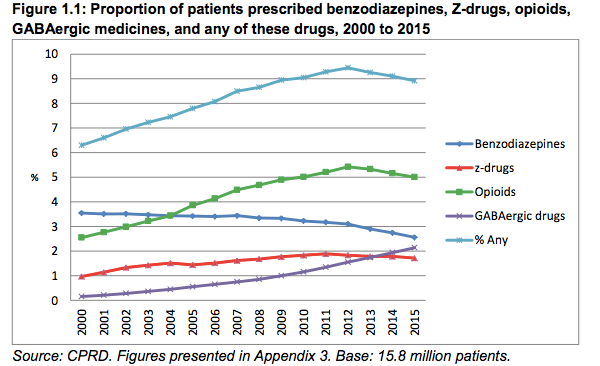
A report from the Public Health Research Consortium (PHR) has shown the increase in use of opioid medication over the past 15 years. This is despite the fact that our understanding of pain and what we can do to overcome pain has advanced enormously in that time. There is a clear mismatch between the pinnacle of pain knowledge and what is known and practiced in society. The gap must close.

Screen Shot 2017-09-08 at 22.30.24
PHRC Final Report: Prescribing Patterns in Dependence Forming Medicines

Chronic pain is the number one global health burden, costing society enormously whilst millions are suffering. This is a public health crisis embedded in society. Whilst doctors are increasingly prescribing opioids, society is also demanding a quick fix in the form of a pill.

There is only one person that can overcome his or her pain

In many or most cases, when someone goes to their doctor they expect to come away with a prescription for a pain killer. They do not expect to receive advice on ‘self-management’ despite the fact that this is exactly what should come first. There can be a role for medicines, but within an overall programme of care that revolves around the person’s own understanding, thinking and actions.

To overcome pain takes understanding, the formation of new (healthy) habits, lifestyle changes, practice and effort

The problem of pain can only be solved with social change. This is the reason for UP, to drive that change by delivering knowledge, skills and know-how to society. To truly understand pain is to be free from the on-going loop of suffering by using our strengths to build wellness. This is the essence of the positive strengths-based Pain Coach Programme, with each person reaching their potential by clarifying their picture of success and learning the principles to follow in order to achieve results.

Screen Shot 2017-09-08 at 23.09.52
BBC News 

UP driving social change

As a purpose-led enterprise UP has the vision of a world where pain is understood to reduce unnecessary suffering. Our purpose is to drive social change with regards to beliefs about pain because we know that people can overcome pain, build on their wellness and live meaningful lives. Understanding pain provides that opportunity together with self-coaching that gets the best out of each individual so that they can reach their potential in whatever circumstances they find themselves.

The Understand Pain and Pain Coach workshops are tailored for the different groups: e.g./ patients, healthcare professionals, schools. The key information is the same, but the workshop structure and the practices are created with the participants in mind. They leave inherently knowing that there is a choice.

The actual experience is a vital part of the process. The sessions are designed to inspire individuals and healthcare teams to learn and grow, provide practical tools that can be used straight away and to integrate their learning in their own unique way that is appropriate for their life.

UP is bound to the principle of delivering positive work to people across the globe. If you would like to partner or connect because you are interested in driving social change for a better world for all, we would love to hear from you. We all have a responsibility to look after each other and the planet and we can choose to do this in our own way. The UP and Pain Coach Programme encourages, educates and enables individuals and groups to build on their innate capacity for wellness by learning and practicing the skills of being well.

In cultivating our ‘wellness’, we create the conditions for a healthy and happy life. Forming a strong foundation of being well that includes such components as self-compassion, purpose, resilience, attention and gratitude means that we become attuned to the existing goodness in us and the world. This does not mean that we do not face adversity, because everyone does at some point. However, practicing being well means that when we do come up against a problem, we can view it as a challenge and an opportunity to learn instead, using and bolstering our strengths. You could say that in fact we are choosing the positive approach as a way onwards.

To overcome pain is not to somehow fight it or to mask the true cause by taking medication. You can’t fight yourself after all. You are your pain as much as any other part or dimension of you. The pain is characteristic of the person as much as their humour or their posturing. Pain is not about tissues or pathology, it is about a perception or prediction of possible danger or threat. To overcome pain is to face the challenge, learn about pain, learn about yourself and how the pain emerges in you, and then transform the experience using practical tools that focus on what you want: your picture of success.

It is not unacceptable for the approach to pain to revolve around medicine. We know too much about what pain really is, what it is for and why we experience persistent or chronic pain. We know that people can get better, lead fulfilling lives and build on their wellness by understanding their pain and what they must do themselves to overcome pain. There is a choice to be had and society need to know that this choice exists. UP strives for the choice to ‘come alive’ across the globe, and we will work tirelessly so that each person can reach their potential for a healthy and happy life.

UP works on a 1 for 1 basis, which means that for each paid workshop delivered, one is provided to the local community within their environment. Please contact us with the form below if you would like to arrange a workshop in your area

← Back

Thank you for your response. ✨

Workshop for CRPS a great success

Understand Pain & Pain Coach Workshop ~ Bath, 2017

“Thank you very much for today. It was a real privilege to attend”

I was delighted that we filled all the places and had to add several more for the CRPS workshop on Monday. It was an excellent afternoon with a really engaged group, keen to understand and know what they can do to move onward. That is the premise for Understand Pain and Pain Coach Workshops, where we deepen our knowledge of pain so that we can focus on what we CAN to be successful and get results.

This was the first UP & CRPS UK workshop at Royds Withy King in Bath, and based on the demand and feedback, we will be rolling out future dates across the UK. We will also be extending the workshops to a day so that we can have even more experiences of success together. The day is all about taking action and having the experience of what that is like, driving and motivating change in your desired direction.

The popular practices we looked at included the mindful practices that can be used in different ways to create calm, insight and focus, the ‘check in’, and journalising. We followed the way that I do in sessions with people 1:1, starting with the vision, strengths and values. This attunes the person to where they are going and the characteristics they possess to use to get there.  Over the afternoon we covered the key areas:

  • Understand Pain
    • What is pain?
    • The size of the problem of pain
    • CRPS criteria
  • Pain Coach
    • The practices that constitute a lived programme that interweaves into the person’s life, whilst they live their life as a means to overcoming pain — becoming a self coach and a self leader

The three main features of the workshops are simple and digestible:

  1. The model of success ~ how we can be successful
  2. Strengths based coaching ~ how to get the best of you
  3. The pinnacle of our knowledge of pain ~ understand pain to change pain

There is no reason why we can’t address pain, learn, transform, and have fun at the same time!

Here are some more comments:

What did people most enjoy?

  • “being in a space to acknowledge pain, guilt free”
  • “Richmond especially, extremely brilliant way with him”
  • “lovely delivery style”
  • “the way the workshop was presented”
  • “very enjoyable”
  • “good explanations. Simple to understand”
  • “very informative”
  • “I did not expect to be challenged as much as I am now following the workshop — positively”
  • “interactive nature of the event”

Come and join us next time!

Future events driving social change

For release in September ~ In conversation: Rich and Pete talk pain. A series of short videos focusing on the key areas of pain. See Pain Coach and Physiotherapist Richmond Stace + Pain Toolkit’s Pete Moore in relaxed conversation. My aim is to create a community so that we can drive social change via new thinking based on new understanding of pain and the action we must take as a society. This is just the beginning. Join us!

FullSizeRender.jpg

Understand Pain & Pain Coach Talk ~ Weds 4th October 2017 at The Royal Society of Medicine ~ click here to book

Understand Pain & Pain Coach Workshop for Clinicians and Therapists ~ Thursday 5th October 2017 in New Malden, Surrey ~ click here to book

We need a new pain definition

What should the definition consider?

Marsaxlokk market with traditional Luzzu fishing boats

Tomorrow I head off to Malta for the Societal Impact of Pain Conference 2017. The areas that will be discussed include:

  1. Pain as a quality indicator for health systems
  2. Building platforms to address the societal impact of pain
  3. Impact of pain on labour and employment
  4. Challenges, models and lighthouses in pain policy
  5. Evolving concepts in the definition of chronic pain: a dynamic process

Overarching the meeting is the multi-stakeholder platform (SiP) that is described on the website as:

The “Societal Impact of Pain” (SIP) is an international platform created in 2009 as a joint initiative of European Pain Federation EFIC® and the pharmaceutical Grünenthal GmbH and aims for

  • raising awareness of the relevance of the impact that pain has on our societies, health and economic systems
  • exchanging information and sharing best-practices across all member states of the European Union
  • developing and fostering European-wide policy strategies & activities for an improved pain care in Europe (Pain Policy).

The platform provides opportunities for discussion for health care professionals, pain advocacy groups, politicians, insurances, representatives of health authorities, regulators and budget holders.

The scientific framework of the SIP platform is under the responsibility of the European Pain Federation EFIC®. Co-operation partners for SIP 2017 are Pain Alliance Europe and Active Citizenship Network. The SIP 2017 symposium is co-hosted by the Malta Health Network and the No Pain Foundation. The pharmaceutical company Grünenthal GmbH is responsible for funding and non-financial support. SIP 2017 is made possible with the financial support of the Ministry for Finance in Malta.

There are some very important conversations that need to be had, and these must then be translated into positive work. I am absolutely focused on the positive work aspect because we need change, society needs change and we need results. I believe that this is achievable. Of course with all this talk of pain, the question is whether we are talking about the same thing?

The IASP definition of pain:

“an unpleasant sensory and emotional experience associated with actual or potential tissue damage, or described in terms of such damage”.

This was published in 1979 and based on work from 1964 by Harold Merskey. Perhaps it is time for an update! The IASP definition certainly captures some of the features but there is one major bit missing as far as I am concerned. The person.

Pain is a whole person experience. Regular readers will have an understanding of pain now, and the fact that pain is not grounded in any structure or pathology (the biomedical model). Instead, pain is part of a whole person state of protection when there is a perceived threat. The key word is perception and much of perception involves biology in the dark and the hidden causes of sensory events; i.e./ we are aware of certain expectations with regards to pain, but most of the biology is going on without our conscious knowing.

A person suffering chronic pain spends a significant amount of time in a state of protect, much by habit. The range of contexts within which the experience emerges in the person widens as threatening situations are increasingly interpreted (biologically and consciously via habits of thought) as threatening.

I would encourage people to think about a definition of pain encompassing these key features:

  • the whole person
  • perception
  • threat

This would be a good start point. From there we can consider the sense of self and how our understanding of this contributes to the experience of pain. I love the notion of ‘expecting yourself’ as put forward by Prof Andy Clark, a leading philosopher who’s work I think will impact enormously on our thinking about pain, together with Dr Mick Thacker and others who are leading the way.

Exciting times and exciting times ahead. There is MUCH hope now and so there should be. This thinking needs to pervade society and this is the purpose of UP, to deliver the right messages and to deliver solutions with results. Positive work to be done!

RS

Pain Coach Workshop for GPs

Why should GPs understand pain?

Audience Applaud Clapping Happines Appreciation Training Concept

Sat 3rd June Education Morning at New Malden Diagnostics Centre

~ Do you understand pain?

Can you confidently answer these questions:

  • what is pain?
  • what do we currently know about the causes of pain?
  • what can the person in pain do to overcome their pain?

Pain is one of the commonest reasons to seek help. And we are not only talking about back pain or neck pain, instead thinking about all the circumstances and conditions that feature pain. Digging deeper, whilst the pain is unpleasant by its very nature, it is the suffering that drives the act of going to the doctor. We can even take this a stage further and suggest that the causes of suffering result in consulting with the GP. For example, the person who cannot work, cannot play with their children, cannot play sports etc. It appears as if life’s choices have disappeared. By definition, suffering refers to the loss of sense of self, and indeed the person with persistent or chronic pain can feel such loss.

The existing understanding of pain has taken us a long way away from the biomedical model. The biopsychosocial model has gained some traction but the predominant approach continues to be driven by the search for an injury, a pathology or a structural explanation. For many years it has been known that pain and injury are not synonymous ~ the famous paper by Pat Wall was published in 1979:

“The period after injury is divided into the immediate, acute and chronic stages. In each stage it is shown that pain has only a weak connection to injury but a strong connection to the body state.

Pain features when we are in a state of protect in the face of a perceived threat. The intensity of the pain relates to this state and not to the extent of tissue damage. Pain and injury are fundamentally different and hence any explanation or treatment for pain based upon the thinking that a ‘structure’ or biomechanics is to blame is at odds with our understanding of pain. In fact, it is this misunderstanding that contributes significantly to chronic pain being the number one global health burden. This can and must change, which is the raison d’être for UP | understand pain.

~ understand pain to change pain

This being the case, this workshop will be a brief look at this enormous societal issue, a public health concern of vast importance considering the massive costs and immeasurable suffering. Not only will we review current thinking and understanding, we will consider the role of the GP and practices that can be readily used.

  • understand pain yourself
  • know your role
  • how can you help the person understand their pain?
  • setting the person on the right course: what is their vision of success?
  • practices you can choose to use in clinic

This overview is based on the Pain Coach Programme. The programme delivers results for people who make the decision to commit to practices that bring about change in a desired direction. They understand that we are designed to change and that we have great potential to be harnessed and used to overcome pain and live a meaningful life.

1:1 Pain Coach Mentoring: for clinicians who choose to pursue understanding pain to a greater level together with the practice of Pain Coaching.

RS