August #upandrun ultra ~ First 50k of North Downs Way
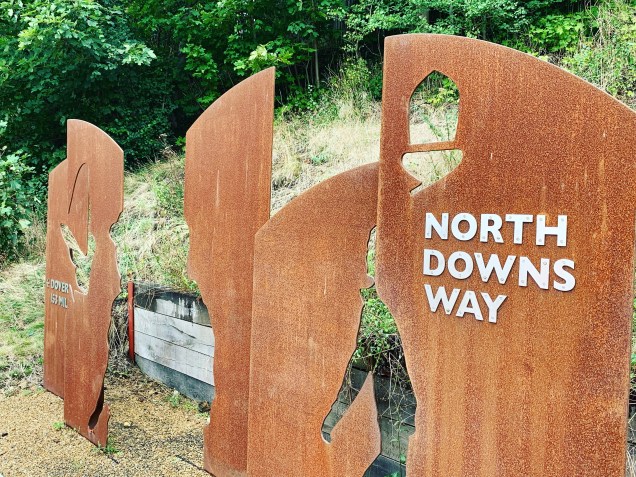
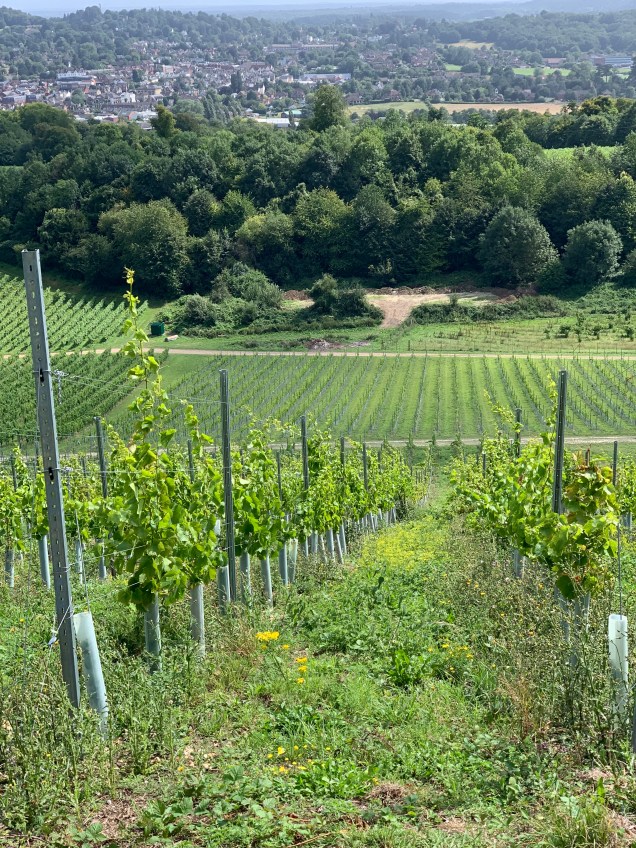
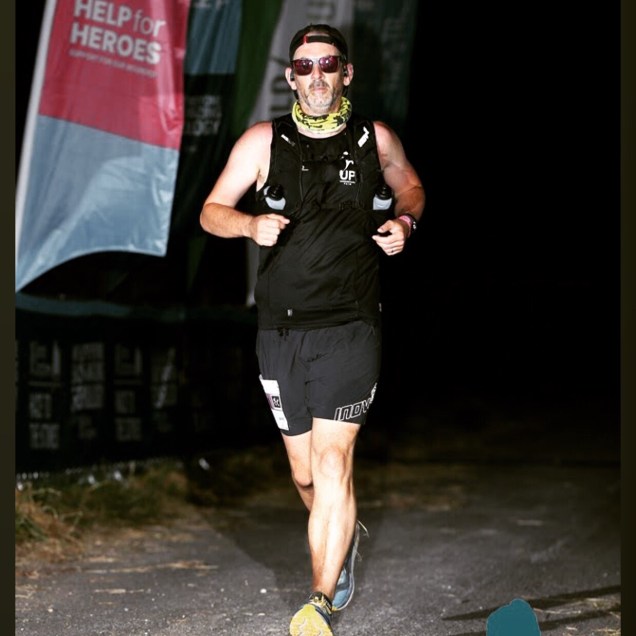
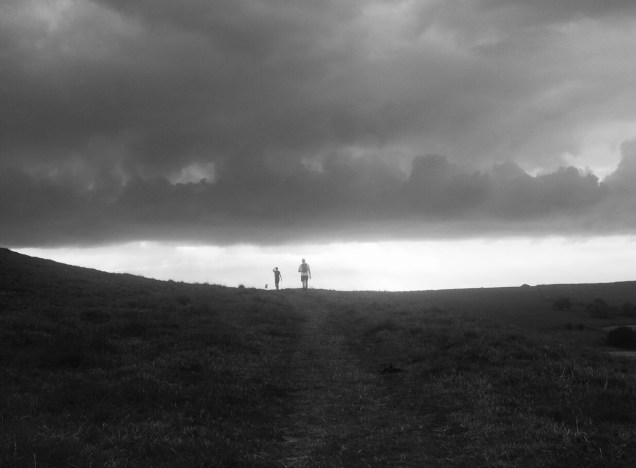
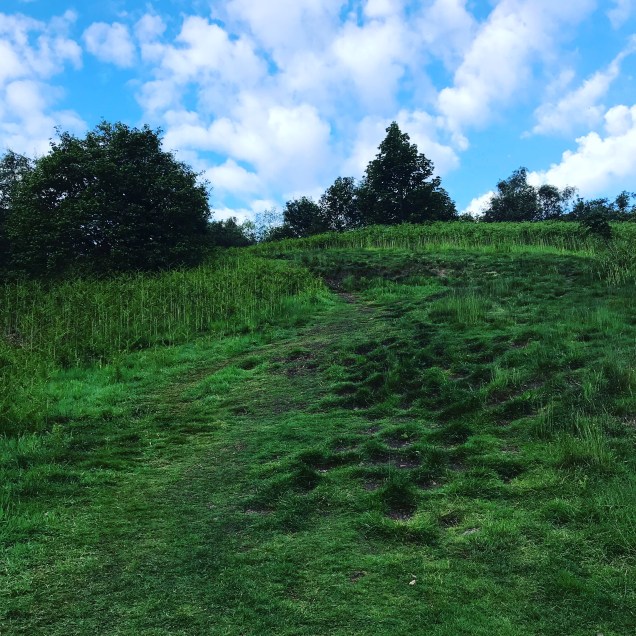
This month’s #upandrun ultra for Understand Pain was Farnham to Betchworth, amounting to 50.9k with an additional loop through a cornfield. For the vast majority of the route I barely saw another person, one of the beauties of a solo run.
Solo runs
These are independent runs when you choose a route, pack your supplies in a backpack and head off alone. In theory there is no support along the way as you decide when to stop and take a break and carry your own food and water.
The prior solo along the Thames Path from Hampton Court to the Thames Barrier offered a number of stopping points: cafes and shops. This time there was a sparsity that added an interesting element. Whilst the elevation was just under 1000m, so pretty steep in places, it is not an overly challenging route. However, it is very scenic along water courses, across fields, along trails and through wooded areas.
I happened upon two pubs. The first was notable, accommodating my seemingly strange request for a banana together with a pint of coke, a pint of water, a pack of salt and vinegar crisps and a double espresso. Steve and Laura at Ye Old Ship Inn just outside Guildford were most helpful. The second was just overpriced using ‘sugar tax’ as an excuse.
The North Downs Way in pictures
#upandrun routes so far…
May ~ Isle of Wight Challenge
June ~ London to Brighton
June ~ Hampton Court to the Thames Barrier
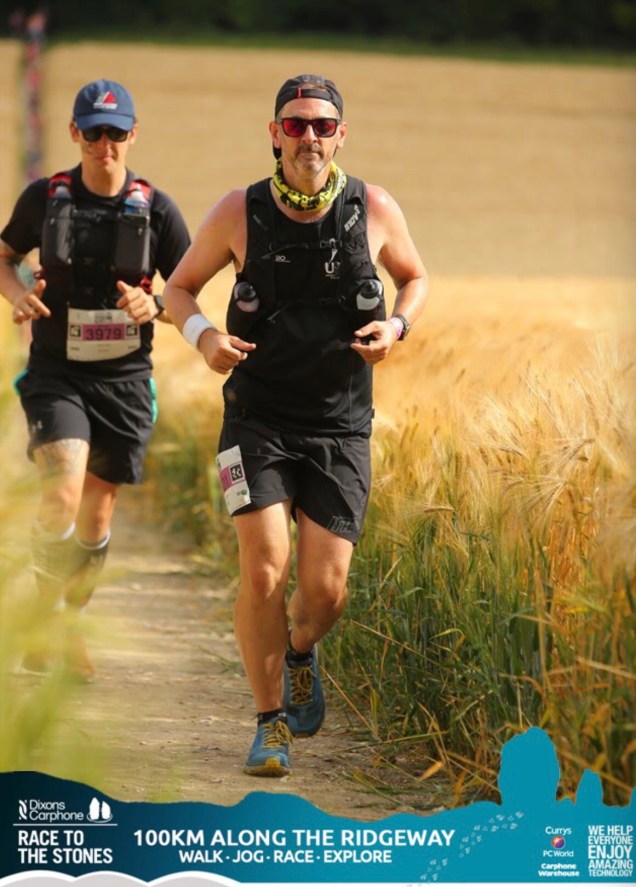
July ~ Race To The Stones
August ~ North Downs Way: Farnham to Betchworth
September and onwards ~ TBC
#12in12
The first #12in12 will take me round to May 2020. However, my plan is to keep going until the Ring O’ Fire in August 2020. And then…..who knows! There’s always another level with ultras, and I am just at the start.
The next run should see me sporting a new outfit having teamed up with a cool running brand. They are also responsible for the funky kit worn by a well known and recognisable ultrarunner in the US. More on this later.
And the reason
To raise the awareness of the global problem of pain — the No1 global health burden. But that’s not it. #upandrun is also about helping people understand their pain and learning ways that they can improve their lives with practical skills and tools. This is via the UP workshops that are running each month in New Malden, Surrey; next one on Wednesday 18th September (tickets available soon). But that’s not it either….
This must build and grow. The workshops must expand and become available far and wide. To do this we must scale the projects and build. This is the work going on behind the scenes at the moment.
Having completed 4 ultras since the start of May this year, the plan is to do #upandrun 12 in 12. That’s 12 ultras in 12 months, or one a month. Some will be races and some will be solos. This could well climate in the Ring O’ Fire, which I am eyeing up and feature Richmond to Oxford along the Thames Path. The latter is 100 miles.
You will be able to sponsor me for this on-going challenge, so look out for the information on that coming very soon.
Don’t forget the UP workshops, next on on Aug 7th at The Groves Medical Centre. You must get tickets, which are free although you can make a donation so that we can build this essential project. Click here
Understand your pain and learn practical ways to improve your life
The UP workshops are now a regular fixture at The Groves Medical Centre, New Malden. Each month I hold a session for people who are suffering persistent pain for any reason.
We clarify pain: what it is? Why it can persist? And how it can change. This is from both a scientific and an experiential viewpoint, enriched by the narratives of the participants. This is of course, your session.
Interwoven into the session are practices and tools that you learn. We do this together. The idea is that you take these away as a way to begin changing the outcomes. Typically people come alone because they are motivated to want their life to look differently, better. And this is what the focus is upon, improving lives.
Do you suffer chronic pain and are you motivated to coach yourself to a better life?
The groups are small and interactive. You will be invited to share your insights and experiences. It is of course up to you whether you decide to share or not. However, this is the real material, the important narrative that in the true reflection of what you have been enduring. But as I said, the primary focus is upon what you want to achieve and the steps to start taking to get there. This is the Pain Coach approach that I use 1:1 with people who come to see me for persistent and complex pain problems.
What next?
Visit the Understand Pain Workshop page here and check for the next date. Click the link for your ticket. The workshops are free but we welcome donations to keep the project going.
Last 10k!
Global workshops & #upandrun
The vision is to reach across the globe and deliver this practical knowledge to people in need. One way will be via online videos that we are working upon, and another is teaching local clinicians. Both are on the agenda. The Pain Coach Programme can be scaled and it can be delivered by any clinician who understands pain. This makes the vision entirely achievable.
At the moment we are building the foundations, but to take it to the level that is needed will require funding. So we seek sponsors and partners who share both the vision and the desire to make a difference.
The #upandrun project is the combo of ultrarunning and the UP workshops. The purpose of the runs are to raise awareness and the the workshops to raise the knowledge and skill level.
If you want to get involved and help us build we would love to hear from you. You can start by emailing me: richmond@specialistpainphysio.com
If you would like to organise an Understand Pain Workshop at your practice, do get in touch.
Chronic pain is deeply embedded within our society. This is where the suffering happens and where the change can occur. It starts with understanding and then choosing the right actions off the back of this knowledge. We can do this together.
This time last week I was well underway from the middle of nowhere south east of Oxford on my way to the middle of nowhere near Swindon. It was Race To The Stones (RTTS) and the final of the planned ultra runs for #upandrun. As my old friend and now UP Ambassador Chris Peskett pointed out, it was also the first that I ran ‘seriously’.
It can take a while to get to ‘serious’. And that’s my experience, as of course others will get stuck in seriously from the outset. There were a good few runners who took on the ultra for the first time and posted impressive times. Hats off.
It began in May with the Isle of Wight Challenge 106k that I ran over two days. Having got rather excited and then hit the lows afterwards, I quickly booked up London to Brighton. This time it was 100k in one go. These were my preparation for RTTS. After London to Brighton I decided to do a solo and ran from home to Hampton Court, before following the Thames Path to the Thames Barrier. That was 62k. Finally, RTTS last Saturday, coming home just before 10pm and soon having a beer….
On The Ridgeway
What’s next?
It’s an exciting time as UP now has two Ambassadors running to raise awareness of our work and plans for the future. Much is going on behind the scenes.
I am truly grateful that I have been able to incorporate the passion for running with my purpose. The running community is wide and global so I hope to build the UP story within this world as a means to reach beyond to all corners of society, helping those most in need: the people suffering.
The runs are a firm fixture. I will be planning the next organised races but also doing a number of solos. As ever the hashtag #upandrun will be the one to follow. The kit is coming together with #upandrun T-shirts and trucker hats for casual wear together with the running attire. We continue to seek sponsors, which would be running brands and businesses that share the vision and the purpose to improve the world by reducing suffering — do get in touch if you want to discuss sponsorship.
UP trucker
The next UP workshop is on August 7th at The Groves Medical Centre — go to this page for the link. Of course this benefits local people and those who can get there, but soon enough the material will be accessible for all via the website.
Please share and help us build. This is about a better society for all, and its only together that we can do this, and we can!
Chris aka ‘Peck’ is a very old friend. Old in that we have known each other since 7 yrs, not that he is old. We navigated our formative years together through two schools and came out the other side. I recall Peck being a runner from an early age, including if I am not mistaken, running home after nights out… .
Moving on.
#upandrun is a project from Understand Pain (UP) that blends running with UP workshops. The running is a way of raising awareness of the No1 global health burden that is chronic pain. The UP workshops deliver practical knowledge and skills to people suffering chronic pain so that they can understand and move on to live fulfilling lives. The vision is to reach as far as we can across the globe. And it all started with a few simple steps… . This includes online versions of the workshops that I am working on at the moment.
Here are some questions I asked Peck:
1. Why do you run?
Because I cant stop, but before that it was because I enjoy being fitter / faster / stronger than I used to be. Not that I’m worried about getting old but I do enjoy the feeling of improvement.
2. What got you into running?
I’d always played sport and the list of sports you can play at 45 is not that extensive!
Next Saturday, I will be on my way, running from The Chilterns, across the North Wessex Downs to Avebury along an ancient path. Race To The Stones is a 100k ultramarathon, and the next in line for #upandrun: the project that combines running with workshops to raise awareness and improve lives.
You can follow my progress on the day with the hashtag #upandrun on both Twitter @painphysio and Instagram @paincoach & @upandlivewell. One of the UP ambassadors, Chris P, is also running next weekend, taking on the Beacons Way Ultra 100. I hope to posting pictures of his progress as well as we track each other.
Running up The Pentland Hills, nr Edinburgh
Look out for the next UP workshop date — an interactive session for people suffering chronic and persistent pain. Come and understand your pain and learn practices, tools and an approach to move on and improve your life.
If you would like to organise an UP workshop near you, please get in touch: richmond@specialistpainphysio.com
Despite piles of research and narratives that have taught us pain and injury are not the same or well-related, this remains the predominant belief in society. It is a belief that informs both self-management and more seriously, professional healthcare management: the search for a structure, injury or pathology to explain pain.
Whilst we must determine the existence of an injury or pathology that may require intervention, this is only ever a part of the story. The lived experience must be the primary focus. The ‘what it is like’ is a unification of thoughts, feelings, perceptions and actions. Bringing these two together is essential, whilst giving the person a clear picture of what is happening. It is complex because we are complex. There’s no need to dumb it down.
It is the person who feels pain, not the body ‘part’
On the London to Brighton ultra a few weeks back, we had criss-crossed the urban areas and reached the countryside. With very little of interest along the Surrey roads, conversation kept you going. There were some very mild slopes but nothing that would be considered ‘technical’. So the foot fall is easy, requiring little or no thought as you trot along establishing a rhythm.
Then you hit the uneven terrain that requires more focus, paying attention to what is coming, adapting to the loose stones, divets, slopes, small mounds hidden by long grass, tree roots and other small obstacles. Duck! That was a low hanging branch, more difficult to clock because it’s a bit darker on the trail in the woods.
Crossing a section of a field that was sun-baked mud with a good covering of grass, my right foot hit the edge of concealed tractor tyre track, woah…! My ankle rolled in and I over the top, but I managed to steady myself and continue. ‘You ok?’, called my running buddy of that section who was just behind. ‘Yep..no problem’, I lobbed back. We carried on. That was about 40k into the 100k day (it ended up around 104k…runner’s were sure the course was longer than it was marked).
We reached the halfway point. Hot food was available and I saw fellow runners tucking into burgers and chips. Food held no appeal, so I forced down some chocolate and fruit together with plenty of fluids. With the second half to go, my feet deserved a check and a change of socks. Inevitably feet sweat and swell, both a risk for blisters. There’s always a little hesitation before removing socks: what will my feet be like?
Remember that what we feel (perceive) and what is going on in the tissues is often different — they are not the same. My state, biological and emotional (that are unified), means that it is entirely possible to experience no unpleasant sensations in my feet, yet I have a reddened area developing or even a formed blister. Checking your feet becomes an essential strategy. A little bit of TLC here and there and all was fine to get going: a couple of preventative Compeeds, a bit of a rub and a stretch.
70-80k was tough. Over half-way, but still 30k to go, including a climb over the Downs. This is a big part of the ‘why?’. At one point I was struggling to get past two other runners who were traveling at barely a walking pace. This is the time to use those mental (embodied) strategies to keep going. You know these moments are going to come; not if but when. I call the my ‘sticky bits’. I also know that they will pass if I keep going.
It was also this time that my right foot started to hurt. The front of my ankle was stinging, accompanied by a sharp pain down the side of the foot. I have a weird little toe on the right that sits up meaning that I use the foot differently to the left. I land and push off more medially. So be it. That’s the way I’m built so there’s no point making a big deal of it, despite what my mind seems to want to say.
There are many things that lift you. People supporting at random places. Some pop up all the way along the route so you get to know them even though they are there to support someone else. Other runners that you come across and then plod along with for a few hours. When else would you meet someone you don’t know and spend hours chatting? The aid stations are GREAT. Usually full of encouragers and definitely packed with treats. Many have said that ultras are eating competitions. I wouldn’t disagree. The normal diet that nourishes goes out of the window as you consume all the naughty stuff that you can get ahold of! Melon has a special place in my heart in these moments. Music and purpose are two further tools that spur me on.
The pain was not abating and if anything was trying to grab more and more of my attention. It didn’t occur to me that maybe I had sprained my ankle until much nearer the end of course. Even then I didn’t give that thought much credence. In essence, it would not be useful to consider this as a possibility. What use would that be? In particular as there was no way I was going to stop anyway.
I love the burst of excitement, energy and emotion that emerges right near the end as the finish line appears. The last few kilometres at dusk, following a looping path towards the Brighton Racecourse, were a push. I wanted to end with a burst so decided to walk a few hundred metres to gather myself. A couple of runners went by and I saw another shadow in the distance behind. There was no way I was going to let him or her pass! I started running again towards the lights in the distance, Brighton below the hills beckoning.
Hitting the longer grass of the racecourse was an unwelcome surprise. Heavy ground and the need to lift my feet meant that I had to bend my knees and flex my hips, neither of which my body was keen to do. But as often happens, there is an easing as you relax into the job in hand, and that is to finish at speed. How often do you see that at the end of a race? The explosion of energy as if some superhuman force has taken over the runner, powering them to glory!
My power burst came, fuel injected with a mantra I can scarcely remembered as I stormed past the two runners who had overtaken me a kilometre or so before. They waved me on, cheering, as is what happens at these events. Everyone supports each other, on a day of sharing an incredibly tough experience, in a way that I have not seen in any other walk of life. It’s a unique camaraderie.
Suddenly it’s over. The last few steps under the inflated finish archway, applauded by the race officials, finishers and other people milling around the end. You know who has run because there’s a style of walking that looks like you’ve…. (you get the picture).
Sleep after a long run for me is an interesting business. Vivid dreams, lots of movement and half waking. The inevitable leg stiffness meant walking to the shower room, all of two meters away, was a challenge. It looked so far away. Ooh, what’s that? I thought as I stepped with my right foot. I looked down and saw the bruising and swelling you can see in the picture at the top of this blog. Indeed I had sprained my ankle. But the pain experience, which is always subjective and uniquely mine, had varied so much since the tractor track incident.
As I looked and wiggled my foot it started to hurt more. Paying more attention to the sensations and what I could see, the discomfort intensified, as it typically does. Of course, when I injure myself it is meant to hurt as a means of helping me protect myself to allow healing to proceed. This is biology in action, and it is going on in the dark. I have no access to this, only what I can feel and see. From there I make assumptions about what has happened and what I must do now for the best. This is all based on my belief that I can get better because I have done before, and there’s no reason to think anything else. Each person will have their own set of beliefs, past experiences and expectations.
Pain and injury are not the same. Pain is subjective — I, the whole person, feel the pain. Injury is objective. They are different and do not relate well. The circumstance, past experience and expectations all play a role, which is why I injured my ankle at 40k and did not really know until the next morning. Pain was and is not a good guide. It just tells me that there is a need to be met as an inference for what maybe happening, yet still compelling action even in the case of no or a minor injury. We are wise to acknowledge and assess, which is why understanding pain is so important. We can then choose the next best action.
As the UP story gathers momentum, in particular the #upandrun project (ultrarunning, marathon running and the UP education programme), we are delighted to welcome two new UP ambassadors: Chris and Jeff. Both will be running for #upandrun so keep an eye out for blogs, pictures and always the hashtag!
If you see #upandrun hashtag, give us a shout out! Take a pic and post it on Twitter or Instagram.
Chronic pain affects so many people for so many reasons. The measure of our success will be how many people we can inspire to move on to live their best lives.
This week look out for…
Richmond running along the Thames Path tomorrow (Thursday) from Hampton Court to the Thames Barrier
Next week look out for…
The UP talk and workshop on Weds 3rd July at 2pm at The Groves Medical Centre. Get your place here >> tickets
Having chatted to my old pal who is a far more experienced runner than I, here are some of the things we spoke about.
Eat before you get hungry
Otherwise it’s too late. Most ultras have rest stops packed with food and drink choices. Early on you may not feel hungry, but eat anyway to stock up for later on when you need the energy.
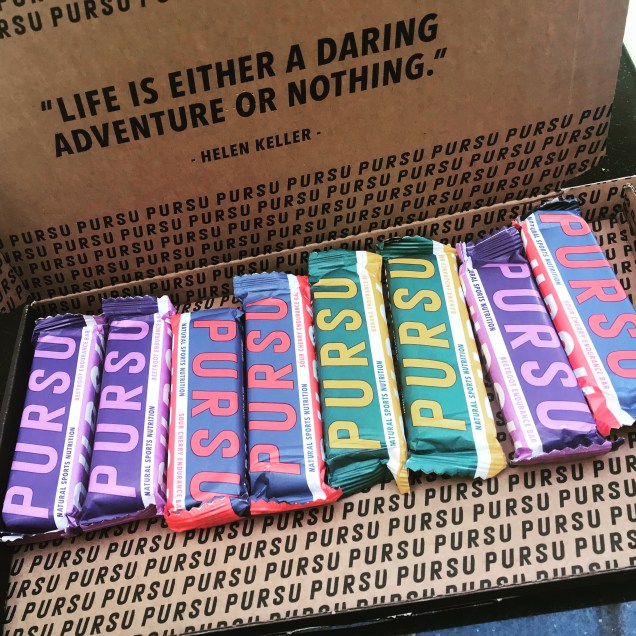
Pursu nutrition
What should I eat? Listen to your body
This is one day when you don’t have to worry about what you are eating (if you do normally). So when you are faced with a table of fruit, sweets, flapjacks, cookies, sandwiches, pizza, pasta, and the rest, what grabs you? Go for it!
Pic N Mix table on the IOW Challenge
Don’t stop for too long
Making a judgement about stopping at the rest stations means considering what fuel and drink you need, stretches that help nourish areas working hard and repetitively and not resting too long. The last point is important because if you are like me, I stiffen fairly quickly meaning it is hard to get going again.
There’s no definite approach, so you must find your own. In that sense, each run is a voyage of discovery! And no run is ever the same so we can only draw loose conclusions anyway.
If you are running and someone walks past, start walking
Sometimes it feels like we are moving along nicely but our perception is different from reality. In particular, on your way up a hill, if others are walking at the same pace or quicker than your run or jog, then save energy and join them.
May 25th London to Brighton 100k ultrachallenge
Tomorrow I will be running from Richmond to Brighton for UP as part of the #upandrun 2019 series for Understand Pain. This week I held an UP workshop at The Groves Medical Centre for people who want to understand pain and know how to move onto live a fulfilling life. There will be future workshops that will be publicised on the website and social media.
Sponsorship and partnering opportunities
We are seeking sponsors and partners for #upandrun to share in the story of improving lives and society. If you are interested, please get in touch: richmond@specialistpainphysio.com
In association with my fuel sponsor Pursu, here are 5 top ultramarathon tips that I have learned so far. There are many, but these have been particularly helpful for me running distances beyond the marathon; so over 26.2 miles.
1. Be curious
People often ask why. However, the answer is not straightforward and each person will have their own reasons why they run for hours and hours, and hours. So you need to be curious about yourself and what you can achieve — what is under your hood? One thing for sure, is that you get to know more about who you are, especially during the long sections when you maybe running alone.
This somewhat blends with your purpose. Some will run for a cause or charity, mine being Understand Pain. This I have written about in the marathon tips blog and the keeping going blog. For the inevitable tough moments that make you and the event, we need strategies to continue putting one foot in front of the other. This ranges from dogged determination to using visualisation. Be curious about how you approach them, what you think, what you do, and how you steer yourself onward.
2. Look after your feet
Running the Isle of Wight Challenge recently, I was surprised at how many people left their foot care until when the blisters had caused them to stop. Some were in a really bad state — agonising. I am sure a number of such folk would have dropped out having done all that preparation. That must be so disappointing, especially when that degree of injury was preventable.
Of course this includes choosing the right footwear. I recently made a mistake that I am now recovering from. Excitedly I selected a pair of road shoes that had too much stability, meaning that I was taking extra strain around my hips, pelvis and lower abdomen. Over months and many miles sensitivity built up — I am sensitive, resulting in feeling sensations and emotions more richly, and frequently aware of bodily sensations. On going for a closer examination of the fitting of my runners, I am now in a neutral shoe and half a size up. Heaven!
On feeling the familiar tingle that warns of a blister coming, be quick to take action. If you are out on a long run, you can dry your foot and apply a dressing such as a Compeed, perhaps even taping it for added security. Choosing good running socks is important as they pull the moisture away from the skin. However, sometimes even with the best care, the sheer number of steps, the temperature and ground conditions cause rubbing and blisters. We just need to minimise the risk and take care early. A further preventative measure is to apply an anti-blister stick to vulnerable areas before running.
3. Fuel
Getting fuelled up before, during and afterwards is vital for these longer runs. Each person must find their own way according to individual needs and tolerances. Some ultra runners eat pizza and burrito at lunch. I can’t stomach that kind of food, instead opt for the stuff my body needs. Working out a plan and trying different foods is part of your training. Don’t leave it to discover on the day that you cannot digest certain things and then find yourself running with a bag of cement in your stomach. Or worse…
Read up on what you need nutritionally and then choose your foods. My basic routine is this: lots of protein and fibre in the week before (chicken, tuna steaks, veg, fruit, flaxseed, nuts, seeds, beetroot); carbs the two days building up to the event (pasta mainly), especially spaghetti bolognese the night before (that’s a tradition now) with extra spaghetti; porridge on the morning of the run with at least one proper coffee, water, Pursu bar, banana and maybe a handful of nuts.
During the run I will sip water and an energy drink (2 bottles in my chest pack). Mostly at the rest stops I take on a banana (potassium), wet fruit (e.g./ melon), cookies, salt and vinegar crisps (salt), shot of coffee (especially in the morning), coke (flat) and water. I carry gels that I use as needed whilst on the go.
Afterwards I usually crave pizza, coke (cold and fizzy), and anything else that is in my path….
4. Enjoy the ride
Typically the longer runs are along scenic routes. I make a point of taking it all in as I am trotting along. One of the privileges of running is being able to see things you would not otherwise see.
Life appears to go by so quickly. My sense of time always shifts dramatically when I am out running for hours. I lose track, and it’s wonderful.
On the IOW Challenge there were long periods of running alone. I like that, but it is also great when you come across and fellow participant. Sometimes you run together for a while and chat. There’s an immediate connection because you are both doing something mad.
5. Look after your body (your whole self)
Not that your body is separate from your embodied mind — the body keeps the score of all your experiences. Regular readers of my blogs about overcoming pain will know that I firmly believe in the notion of the whole person.
That said, the conditioning behind the scenes is an important part of the training programme. In brief, the main components should include strength, body control (balance work) and flexibility (yoga, stretching). Often I speak to amateur runners, even those who are accomplished, and they pay little attention to conditioning their body. There are two primary risks of this approach: (1) injury (2) not reaching your potential.
Day to day behind the scenes routines make the difference: diet, sleep, how you manage your life, regular movement (especially if you have a sedentary job), how you roll with the inevitable ups and downs of life. The race is just the tip of the iceberg; the reward if you like. This depends upon the running training but also how you look after yourself. With athletes, I spend time with them looking at ways that they can improve their outcomes by best managing all these areas of life that are inseparable, much as mind and body are inseparable. You are a whole person, on a timeline when nothing happens in isolation.
For more on this, please contact me: richmond@specialistpainphysio.com











 understand pain