…or so it has become the night before an ultra. Spaghetti Bolognese, full fat Coke and ice-cream.
This was supposed to be a simple train ride to Eastbourne. But, somehow I ended up on the wrong part of the train and arrived in Hove. Back to Brighton I went in hope of catching the next train to Eastbourne.
How would I get my spag bog? I’ll pause in Brighton and find an Italian. What a find! Pinocchio’s just off the North Laines was vibrant and smelt good. The waiter said he could deliver my meal pronto and so he did — see above. Then came the massive white chocolate ice-cream studded with white buttons and honeycomb; great!
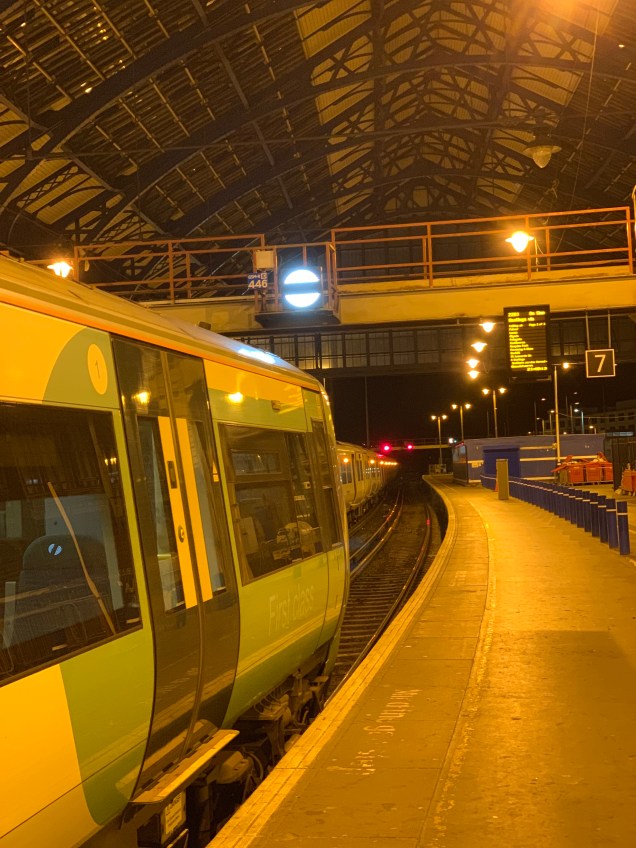
The night train
Now off to Eastbourne at last. It will be bed by midnight, but I don’t sleep well before a race anyway. I usually wake every hour or so, thinking it is time to get up before realising that it is not, and try to go back to sleep. The pattern repeats.
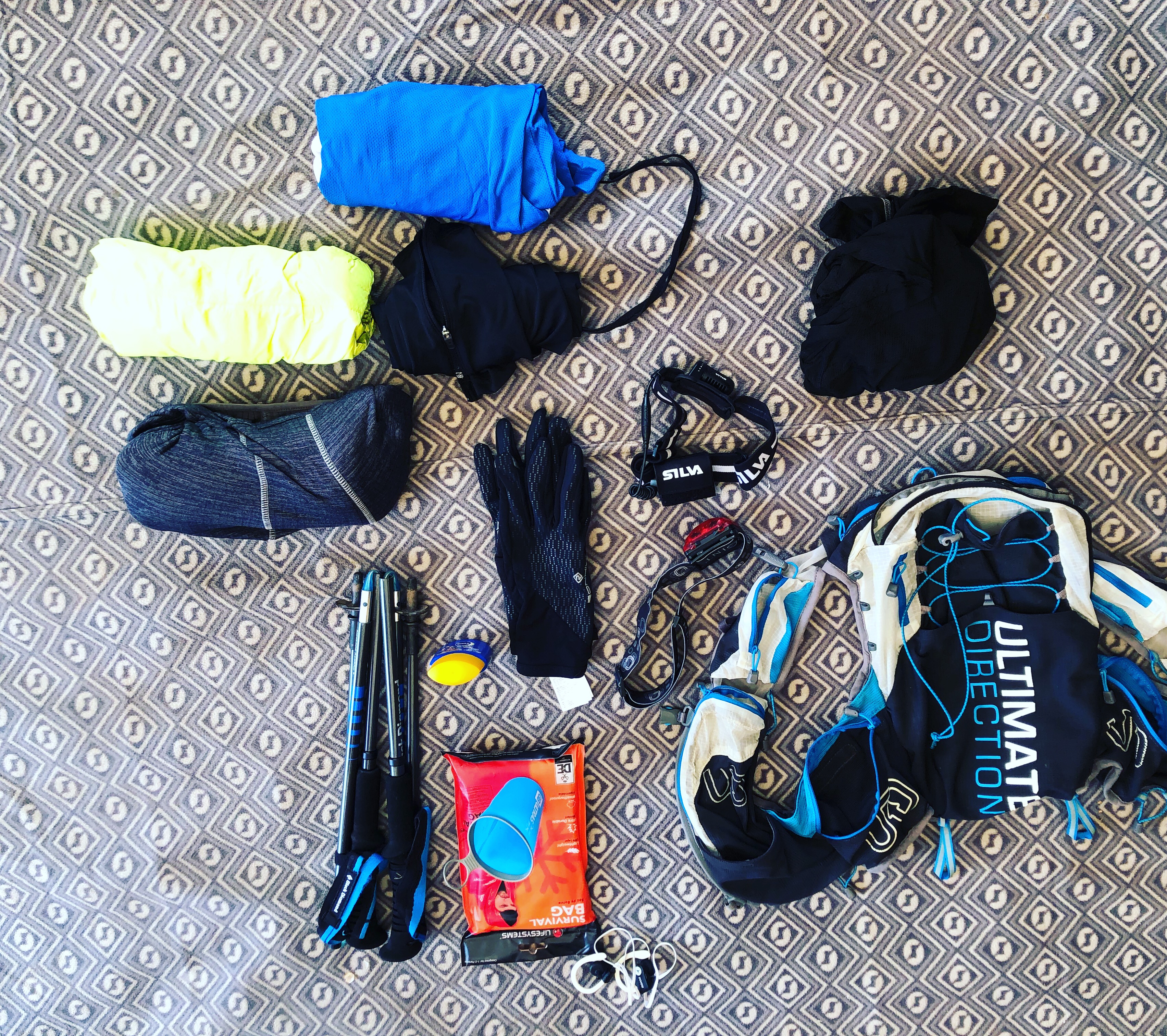
Essential kit
I travel light. Wearing the shoes, ‘my ride’, I pack the essentials only for running. A vest, bottles, first aid pack, spare socks, a second layer, head torch, belt, headphones, cap, buff, sweat band, credit card, charging pack.
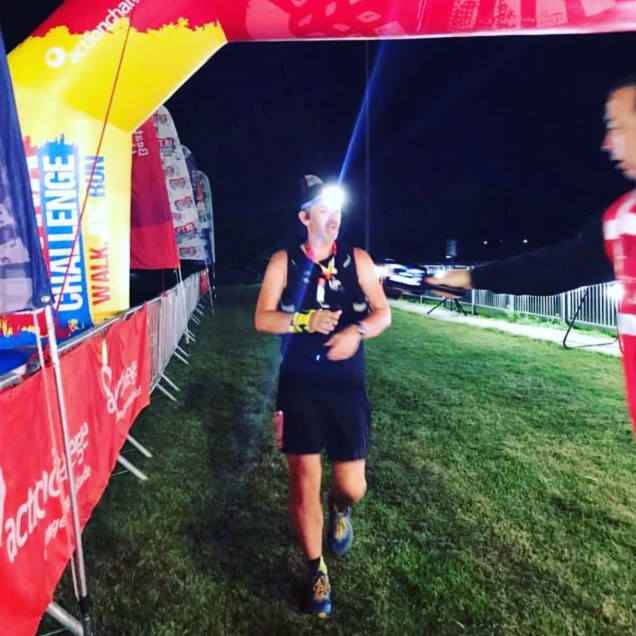
The South Coast Challenge tomorrow will be the third 100k run in three months. You start to know what to expect. Times to push and times to hold back become more apparent. Rest stops are planned more closely, and on this particular course, they appear every 10-15k. This may not sound too far. It’s the terrain that has the impact. Tougher terrain can mean it takes 10 minutes to complete 1k, or longer sometimes.
I learned on Race To The Stones that a little lunch (pasta) worked well, together with a foot inspection and change of socks (sweat = damp socks = blister risk). Slipping into a fresh pair has served me well on both the prior 100s.
Visualisation, breathing and meditation are all part of the routine the night before and on the morning. Creating calm and clarity, rehearsing mantras and tools for the inevitable tough moments means being prepared. It’s not a case of will it hurt, but when. I call these the sticky bits. This is the time to keep the feet moving. Plodding along. The ultra shuffle some call it.
Several days before I always experience some interesting bodily sensations. My right foot always hurts, together with my ankle and often the right leg as a whole. Throbbing, tightness, pulling, and a touch of strain all call out like individual voices, a choir perhaps. It’s a little reminder of past sensitivities and that something vigorous is coming up.
An ultra is like life. There’s a beginning and an end, with a sequence of things happening in between. Things always happen. It’s the response that is key in making it what it is for me. How do I respond automatically due to learning, social conditioning and genetics? And how do I choose to respond to those responses? Again, it’s not a matter of if life will have tougher, challenging moments, but when? I need to be prepared, to use those moments to learn and move on. How can I best deal with it? How can I get back on track quickly?
Next stop Eastbourne. Follow my progress tomorrow if you like: #upandrun on Twitter (@painphysio) and Instagram (@paincoach).
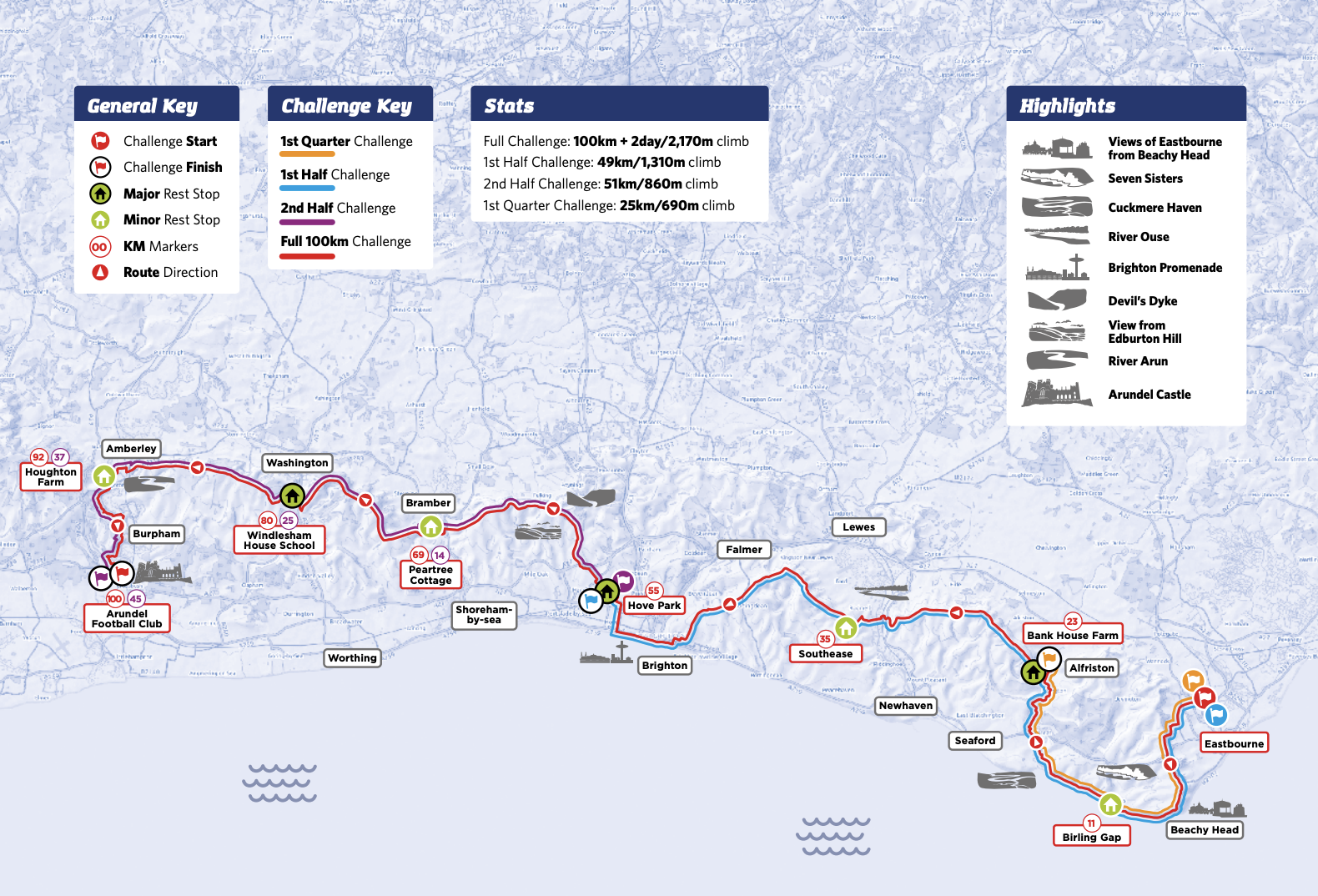
The next in the #12in12 ultra series for #upandrun is the South Coast Challenge 100km, from Eastbourne to Arundel.
The course follows an undulating route across the South Coast taking in Beachy Head, Brighton and the South Downs along the way.
You can follow the run on the day on Twitter with the usual hashtag #upandrun & @painphysio and on Instagram. I will be posting photos and videos on the way round.
And as ever, the purpose is to raise awareness of the problem of pain; the No1 global health burden.
August #upandrun ultra ~ First 50k of North Downs Way
This month’s #upandrun ultra for Understand Pain was Farnham to Betchworth, amounting to 50.9k with an additional loop through a cornfield. For the vast majority of the route I barely saw another person, one of the beauties of a solo run.
Solo runs
These are independent runs when you choose a route, pack your supplies in a backpack and head off alone. In theory there is no support along the way as you decide when to stop and take a break and carry your own food and water.
The prior solo along the Thames Path from Hampton Court to the Thames Barrier offered a number of stopping points: cafes and shops. This time there was a sparsity that added an interesting element. Whilst the elevation was just under 1000m, so pretty steep in places, it is not an overly challenging route. However, it is very scenic along water courses, across fields, along trails and through wooded areas.
I happened upon two pubs. The first was notable, accommodating my seemingly strange request for a banana together with a pint of coke, a pint of water, a pack of salt and vinegar crisps and a double espresso. Steve and Laura at Ye Old Ship Inn just outside Guildford were most helpful. The second was just overpriced using ‘sugar tax’ as an excuse.
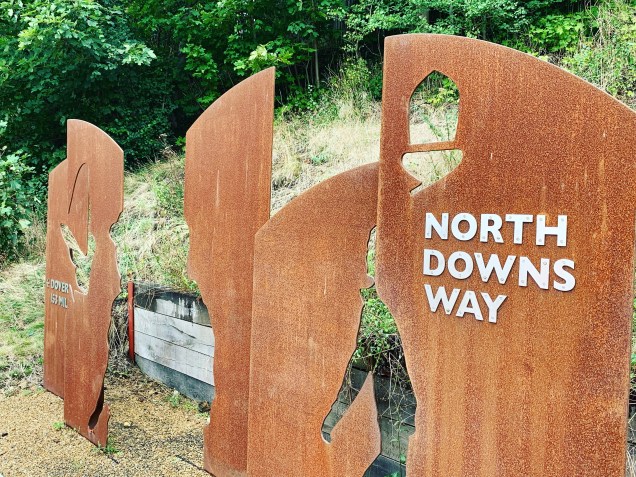
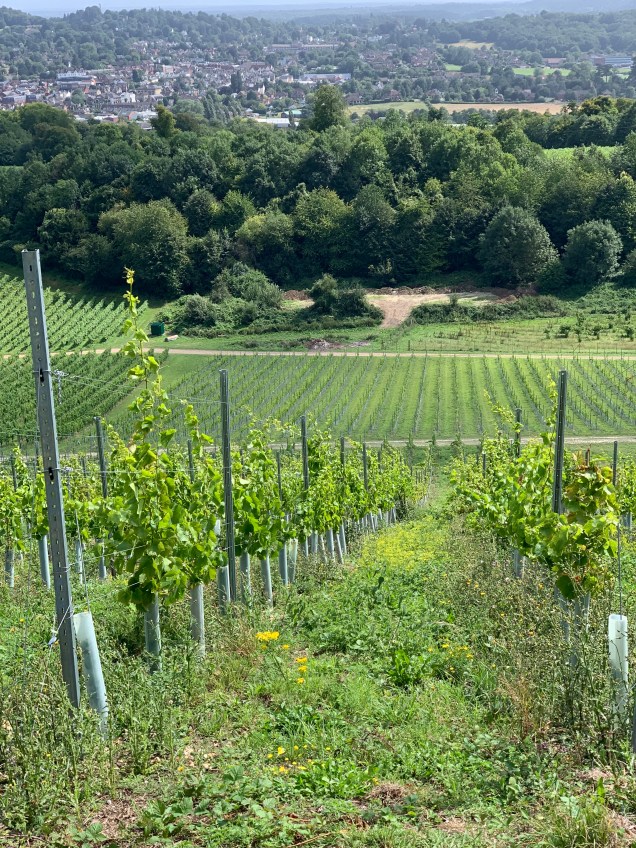
The North Downs Way in pictures
#upandrun routes so far…
May ~ Isle of Wight Challenge
June ~ London to Brighton
June ~ Hampton Court to the Thames Barrier
July ~ Race To The Stones
August ~ North Downs Way: Farnham to Betchworth
September and onwards ~ TBC
#12in12
The first #12in12 will take me round to May 2020. However, my plan is to keep going until the Ring O’ Fire in August 2020. And then…..who knows! There’s always another level with ultras, and I am just at the start.
The next run should see me sporting a new outfit having teamed up with a cool running brand. They are also responsible for the funky kit worn by a well known and recognisable ultrarunner in the US. More on this later.
And the reason
To raise the awareness of the global problem of pain — the No1 global health burden. But that’s not it. #upandrun is also about helping people understand their pain and learning ways that they can improve their lives with practical skills and tools. This is via the UP workshops that are running each month in New Malden, Surrey; next one on Wednesday 18th September (tickets available soon). But that’s not it either….
This must build and grow. The workshops must expand and become available far and wide. To do this we must scale the projects and build. This is the work going on behind the scenes at the moment.
#upandrun is an Understand Pain project raising awareness of the problem of pain — the No1 global health burden. We are working to reduce the enormous suffering caused by chronic pain that affects millions and costs billions.
Having completed 4 ultras since the start of May this year, the plan is to do #upandrun 12 in 12. That’s 12 ultras in 12 months, or one a month. Some will be races and some will be solos. This could well climate in the Ring O’ Fire, which I am eyeing up and feature Richmond to Oxford along the Thames Path. The latter is 100 miles.
You will be able to sponsor me for this on-going challenge, so look out for the information on that coming very soon.
Don’t forget the UP workshops, next on on Aug 7th at The Groves Medical Centre. You must get tickets, which are free although you can make a donation so that we can build this essential project. Click here
Understand your pain and learn practical ways to improve your life
The UP workshops are now a regular fixture at The Groves Medical Centre, New Malden. Each month I hold a session for people who are suffering persistent pain for any reason.
We clarify pain: what it is? Why it can persist? And how it can change. This is from both a scientific and an experiential viewpoint, enriched by the narratives of the participants. This is of course, your session.
Interwoven into the session are practices and tools that you learn. We do this together. The idea is that you take these away as a way to begin changing the outcomes. Typically people come alone because they are motivated to want their life to look differently, better. And this is what the focus is upon, improving lives.
Do you suffer chronic pain and are you motivated to coach yourself to a better life?
The groups are small and interactive. You will be invited to share your insights and experiences. It is of course up to you whether you decide to share or not. However, this is the real material, the important narrative that in the true reflection of what you have been enduring. But as I said, the primary focus is upon what you want to achieve and the steps to start taking to get there. This is the Pain Coach approach that I use 1:1 with people who come to see me for persistent and complex pain problems.
What next?
Visit the Understand Pain Workshop page here and check for the next date. Click the link for your ticket. The workshops are free but we welcome donations to keep the project going.
Last 10k!
Global workshops & #upandrun
The vision is to reach across the globe and deliver this practical knowledge to people in need. One way will be via online videos that we are working upon, and another is teaching local clinicians. Both are on the agenda. The Pain Coach Programme can be scaled and it can be delivered by any clinician who understands pain. This makes the vision entirely achievable.
At the moment we are building the foundations, but to take it to the level that is needed will require funding. So we seek sponsors and partners who share both the vision and the desire to make a difference.
The #upandrun project is the combo of ultrarunning and the UP workshops. The purpose of the runs are to raise awareness and the the workshops to raise the knowledge and skill level.
If you want to get involved and help us build we would love to hear from you. You can start by emailing me: richmond@specialistpainphysio.com
If you would like to organise an Understand Pain Workshop at your practice, do get in touch.
Chronic pain is deeply embedded within our society. This is where the suffering happens and where the change can occur. It starts with understanding and then choosing the right actions off the back of this knowledge. We can do this together.
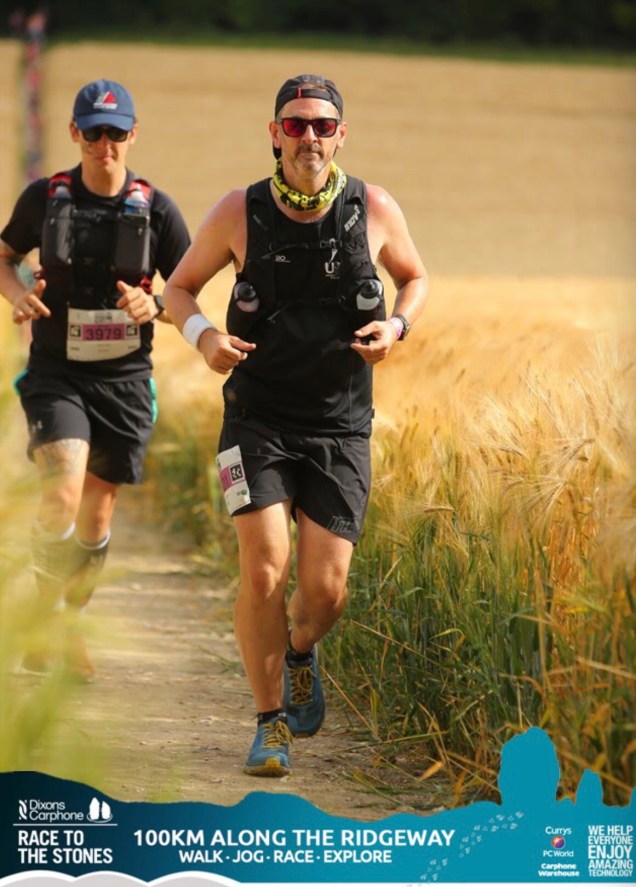
This time last week I was well underway from the middle of nowhere south east of Oxford on my way to the middle of nowhere near Swindon. It was Race To The Stones (RTTS) and the final of the planned ultra runs for #upandrun. As my old friend and now UP Ambassador Chris Peskett pointed out, it was also the first that I ran ‘seriously’.
It can take a while to get to ‘serious’. And that’s my experience, as of course others will get stuck in seriously from the outset. There were a good few runners who took on the ultra for the first time and posted impressive times. Hats off.
It began in May with the Isle of Wight Challenge 106k that I ran over two days. Having got rather excited and then hit the lows afterwards, I quickly booked up London to Brighton. This time it was 100k in one go. These were my preparation for RTTS. After London to Brighton I decided to do a solo and ran from home to Hampton Court, before following the Thames Path to the Thames Barrier. That was 62k. Finally, RTTS last Saturday, coming home just before 10pm and soon having a beer….
On The Ridgeway
What’s next?
It’s an exciting time as UP now has two Ambassadors running to raise awareness of our work and plans for the future. Much is going on behind the scenes.
I am truly grateful that I have been able to incorporate the passion for running with my purpose. The running community is wide and global so I hope to build the UP story within this world as a means to reach beyond to all corners of society, helping those most in need: the people suffering.
The runs are a firm fixture. I will be planning the next organised races but also doing a number of solos. As ever the hashtag #upandrun will be the one to follow. The kit is coming together with #upandrun T-shirts and trucker hats for casual wear together with the running attire. We continue to seek sponsors, which would be running brands and businesses that share the vision and the purpose to improve the world by reducing suffering — do get in touch if you want to discuss sponsorship.
UP trucker
The next UP workshop is on August 7th at The Groves Medical Centre — go to this page for the link. Of course this benefits local people and those who can get there, but soon enough the material will be accessible for all via the website.
Please share and help us build. This is about a better society for all, and its only together that we can do this, and we can!
Chris aka ‘Peck’ is a very old friend. Old in that we have known each other since 7 yrs, not that he is old. We navigated our formative years together through two schools and came out the other side. I recall Peck being a runner from an early age, including if I am not mistaken, running home after nights out… .
Moving on.
#upandrun is a project from Understand Pain (UP) that blends running with UP workshops. The running is a way of raising awareness of the No1 global health burden that is chronic pain. The UP workshops deliver practical knowledge and skills to people suffering chronic pain so that they can understand and move on to live fulfilling lives. The vision is to reach as far as we can across the globe. And it all started with a few simple steps… . This includes online versions of the workshops that I am working on at the moment.
Here are some questions I asked Peck:
1. Why do you run?
Because I cant stop, but before that it was because I enjoy being fitter / faster / stronger than I used to be. Not that I’m worried about getting old but I do enjoy the feeling of improvement.
2. What got you into running?
I’d always played sport and the list of sports you can play at 45 is not that extensive!
Are you a GP who sees people suffering chronic pain?
The answer is most likely yes considering 20% of the population suffer chronic pain. There are many presentations (in no particular order): back pain, neck pain, irritable bowel syndrome, fibromyalgia, arthritis, post-injury, headaches, migraines, pelvic pain, endometriosis, menstrual pain, tendonitis, as a feature of a particular condition, cancer, heart disease and more.
Chronic pain is the No1 global health burden. Pain is the main reason why people seek help. Yet it remains poorly understood, meaning that people’s expectations are out of step with what they need to get better, and the treatment offered can take them down the wrong path. Together these contribute to the on-going problem that is showing no signs of change in the right direction: less suffering and less cost. We must and can make this happen. The ‘we’ being society.
GPs are in a prime position to help drive this change with the right support and systems in place. As a GP or healthcare clinician, how do you feel when a patient (person) suffering chronic pain comes into your room? Be honest. Does the challenge excite you, or is it the so-called ‘heart-sink’ time? For me, I have always loved the challenge and the fact that we can always do something to help the person improve their life. But this is because I have always felt that I can work in this specialist field and make a difference, building knowledge and experience over 20 years. Without the practical knowledge and the coaching approach, I am certain I would feel lost and overwhelmed.
Now, I do not believe that you need 20 years in the world of pain to be able to have a positive impact. But I do know that understanding pain is vital, as is having confidence in your approach. Both are transmitted to the person in front of you whether you are aware or not.
Steps to take
The first step is to be aware of your own beliefs, biases and behaviours in these situations. These will frame your approach. What is your approach? Establishing the way you ‘treat’ is the next step. Do you treat chronic pain? Do you treat the person? Do you coach the person? What do you do, how and why?
On knowing your start point, you can then build your knowledge of pain: what is pain really? For example, understanding that pain and injury are poorly related, that pain and tissue state bear little relation to each other, that pain is a need state, and that pain is the brain’s best guess to explain the current state. Further, you learn that pain is related to the perception of threat and the state of the person. It is of course the person who suffers pain, not the body part. And, most of the biology in the dark when we are in pain, is not actually where we feel it. The pain experience itself is just the tip of the iceberg.
Your process
You have a choice. You can continue using the same approach, and indeed there may well be some ways that you find to be effective. Or you can add to your repertoire of tools and design a system or process. This I can help you create.
One of the biggest challenges is always the time factor. Perhaps you have 7 minutes, 10 minutes or the ‘luxury’ or more. It is tight. This is a complex situation that requires time and the human touch. How can effective care be achieved? How can we really help this person improve their life? The primary choice remains medication. There is a role for medication and it is often expected by the person and hence a pressure to prescribe exists. However, whether you do or not is your choice as the clinician. But of course medication does not teach someone how to improve their life and will mean that the natural systems of (biological) protection become lazy together with a limitation upon the person’s responses. People commonly rely upon and hope for the quick fix option when there is none. Instead there is a way forward that eases suffering and improves life, but it takes longer and is more effort. That is the reality, the uncomfortable and inconvenient truth about chronic pain.
To address pain you have to address your needs in life, build wellness, create new heathy habits, take a new perspective, expect and know that life can get better and practice day to day to day, much like cleaning your teeth — you know this is true when you truly understand pain.
The questions are: what does this person really need? What are they telling you in the narrative? And then, how good are my deep listening skills?
So, with limited time and the desire to make a positive impact, we need a plan. One that we can roll out in an individual way. We need a set of options and resources that can meet the needs of the person step by step. When you know that you have a plan, the pressure eases because you know that you can make a positive impact. You outline the plan to the patient, start the wheels turning as you help them understand their pain (always the key), and focus on what they CAN do to improve their life.
#upandrun project >> ultrarunning + UP workshops to help people understand pain and move on to a fulfilling life
The Pain Coach approach focuses upon what the person wants in their life and how they want their life to be: focus on what you want, not what you don’t want. See how often we do the latter, and sure enough…. . This is why coaching offers so much because we tap into the person’s strengths to move on towards their picture of success. We have a clear direction and steps to take each day. It is a challenge, but coaching encourages and supports the person to live their best life, to show up in the best version of themselves, and to reach their potential.
What would it be like if you had a process?
How would you feel about supporting, encouraging and coaching people suffering chronic pain if you knew that you had a process in place? Would this have a positive impact upon their lives? Your practice? Your stress levels? Costs?
Your process includes a range of ways that you address particular problems that arise together with resources to call upon. Within each session you have 1-2 key points to cover. Sessions are scheduled according to the priorities for that person. This removes some of the time pressure because instead of trying to cram in as much as possible, or prescribing as the first port of call, you know that you have a number of appointments set up for particular issues to be discussed and acted upon.
In essence, when a person has an idea about what is happening, why, what they must do, what the clinician will do and over a rough time period, they will be satisfied and engage. The trusted advisor status is vital when working with someone suffering chronic pain. This takes time and follows reliable, compassionate care, i.e./ positive actions in line with the person’s needs.
Summing up
There are many pressures upon GPs. From society, patients, and themselves to deliver the best care. Resources are always limited in some shape or form, in particular the most valuable one: time. This being the case, we must work out the best ways of moving forward. For chronic pain, currently the greatest health burden, creating a process within your practice that enables you to listen (deeply) to the patient, and step by step meet their needs will increase efficiency and improve outcomes. Within this process, pain coaching is a means of working with the person so that they can reach their potential.
For more information about Pain Coach Mentoring for you or your practice and Understand Pain Workshops for people suffering pain, contact us here >> richmond@specialistpainphysio.com





















 understand pain