Talking pain ~ video series

Together with Pete of The Pain Toolkit, I have been talking pain. This is a simple way of getting across the key messages about pain in bite-sized videos.

The first chat was based on the 5 question challenge when Pete asked me how I ‘got into pain’, my story in other words, and then what I say to people who are seeking the quick fix, the future of how we will deal with pain and the role of social media. Today we dug down deeper into dispelling the myth of the quick fix as an option.

In brief, overcoming pain is one of life’s challenges. Embracing this as a problem to solve by living one’s best life delivers many possibilities. This turns the traditional thinking, which has not worked (otherwise chronic pain would not be the No1 global health burden), on its head; i.e. we get back to living by living, not waiting for something to happen, or relying on hopes. Instead we follow a route of mastery, creating lasting and positive change, achieving results and maintaining a consistent course towards a desired outcome. This IS the model of success and we can apply this here, in addressing pain.

So, there is no quick fix, instead a route forwards where we fill our lives with the good stuff! We use our natural resources and strengths, and become resourceful. Everything you need is right there, and once you release yourself from the old, limiting beliefs and conditioned thinking (I can’t…I won’t….tomorrow etc etc.), you can start taking steps towards success. Is this a pain-free life? Does it mean being ‘happy’ all the time?

Pain is part of life. The pain you may be feeling has persisted and is not indicative of a tissue issue or pathology in many cases. Instead it is an on-going protect state as more and more contexts and situations generalise as being a threat — even though they are not. We have to actively re-train this, gain control over our mind rather than the mind controlling us, because once we decide to commit to consistent practices that build health, wellness and joy, they shift us into a different state, or chemistry. That is how we overcome pain. The more we focus on treating pain, the worse the outcomes. The more we focus on the person living well, the better the outcomes — for what we focus upon governs how we feel and where we put our energy. What do you want? Where are you going to pout your energy? Into a life full of joy? Or a life full of pain?

It sounds easy when you put it like that! Of course it is a challenge and there are many ups and downs. But you do not have to let that get in the way of you deciding to commit to a new path, one that you follow to gain wins and success in all areas of your life — again, because you decided to. How often do you feel happy, just because you can? Now you can use that as a daily practice!

So, onwards we go, as this is the only direction of travel. We build our ability to change state into that of excitement, determination, joy, love, compassion and all the many other states .We can get into such high energy states by moving, breathing, visualising, connecting and many other simple day to day practices. It merely takes the decision to do so, the development of a routine and practice, or repetitions, just like strengthening a . muscle.

More answered questions to come! You can email us your questions (painphysiolondon@gmail.com) or come to twitter and tweet @painphysio

In the meantime, enjoy!

For more information about the The Pain Coach Programme, click here

Talking pain with Pete

Pain Coach + Pain Toolkit getting together to deliver the RIGHT messages about chronic pain

This is the first of a series of conversations about pain. Pete’s 5 question challenge:

  • how did you get into pain?
  • what about people looking for a quick fix?
  • what questions should patients ask me?
  • is social media useful?
  • what is the future for pain management?

A series of chats coming soon. Enjoy!

Pain Coach Workshops ~ supporting the next generation of therapists and clinicians

A week ago we had another Pain Coach Workshop. This time in Wilmslow, near Manchester. A great spot with some excellent local cafes. I do love a cafe.

Regular readers will be familiar with the UP story, the UP vision and how we are supporting the next generation of clinicians and therapists by providing two sponsored places for local undergraduates.

Everyone who attends the Pain Coach Workshop brings immense value to the day. Purposely a small group to create a positive dynamic, the team all add their experience and views. In particular I enjoy hearing from the current undergraduates–the openness, freshness and the beginner’s mind that I encourage is evident.

Sam and Emma from Salford University came to the Wilmslow workshop, and here is what Sam had to say:

Here’s what Sam had to say:

I have recently completed the Understanding Pain & Pain Coach Workshop lead by Richmond Stace. I am a physiotherapy student, and was lucky enough to receive a free place that Richmond provides to support local undergraduate development.
I became interested in this workshop due to my time out on placement, in which I was challenged with chronic pain patients. Many patients had been seen by numerous health professions prior to myself, and suffering with pain for many years. I did not feel equipped to deal with this patient group who had deeply established pain belief systems and pain embedded within their lives. I believe as a student, it is important to develop the ability and confidence in which you can challenge a patient’s understanding of pain.

I understood the approach of ‘Making Every Contact Count’ was vital to encourage physical activity and promote behaviour changes that lead to a healthier lifestyle. However, I now feel that the approach of ‘Making Every Contact Count’ needs to extend to pain coaching. The course has provided me with the tools to encourage patients to understand pain and most importantly, gain control over it. This is a skill that will need to be practiced, and as a student it is the perfect time to develop and create change in ourselves, in-order to create change for our patients.

I thoroughly enjoyed this workshop, it was great to share the day with experienced physiotherapists and it was a fun learning experience. Richmond’s passion, values and drive is infectious and I cannot wait to graduate to develop my abilities to encourage, educate and enable change. A big thank you to Richmond for this great learning opportunity and I would encourage all physiotherapy students to attend!

The next Pain Coach Workshop is in Newport on Sat November ~ see here

Much more to come in the 2018!

Opioid painkiller prescriptions increase

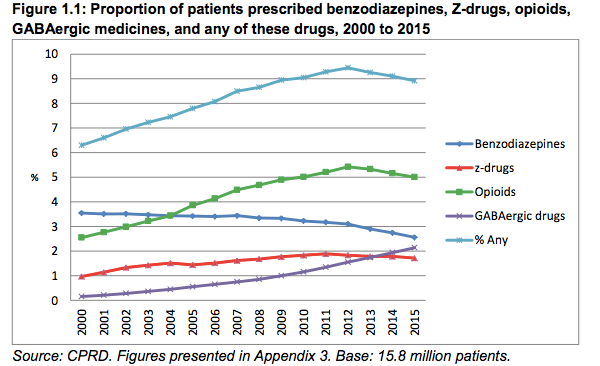
A report from the Public Health Research Consortium (PHR) has shown the increase in use of opioid medication over the past 15 years. This is despite the fact that our understanding of pain and what we can do to overcome pain has advanced enormously in that time. There is a clear mismatch between the pinnacle of pain knowledge and what is known and practiced in society. The gap must close.

Screen Shot 2017-09-08 at 22.30.24
PHRC Final Report: Prescribing Patterns in Dependence Forming Medicines

Chronic pain is the number one global health burden, costing society enormously whilst millions are suffering. This is a public health crisis embedded in society. Whilst doctors are increasingly prescribing opioids, society is also demanding a quick fix in the form of a pill.

There is only one person that can overcome his or her pain

In many or most cases, when someone goes to their doctor they expect to come away with a prescription for a pain killer. They do not expect to receive advice on ‘self-management’ despite the fact that this is exactly what should come first. There can be a role for medicines, but within an overall programme of care that revolves around the person’s own understanding, thinking and actions.

To overcome pain takes understanding, the formation of new (healthy) habits, lifestyle changes, practice and effort

The problem of pain can only be solved with social change. This is the reason for UP, to drive that change by delivering knowledge, skills and know-how to society. To truly understand pain is to be free from the on-going loop of suffering by using our strengths to build wellness. This is the essence of the positive strengths-based Pain Coach Programme, with each person reaching their potential by clarifying their picture of success and learning the principles to follow in order to achieve results.

Screen Shot 2017-09-08 at 23.09.52
BBC News 

UP driving social change

As a purpose-led enterprise UP has the vision of a world where pain is understood to reduce unnecessary suffering. Our purpose is to drive social change with regards to beliefs about pain because we know that people can overcome pain, build on their wellness and live meaningful lives. Understanding pain provides that opportunity together with self-coaching that gets the best out of each individual so that they can reach their potential in whatever circumstances they find themselves.

The Understand Pain and Pain Coach workshops are tailored for the different groups: e.g./ patients, healthcare professionals, schools. The key information is the same, but the workshop structure and the practices are created with the participants in mind. They leave inherently knowing that there is a choice.

The actual experience is a vital part of the process. The sessions are designed to inspire individuals and healthcare teams to learn and grow, provide practical tools that can be used straight away and to integrate their learning in their own unique way that is appropriate for their life.

UP is bound to the principle of delivering positive work to people across the globe. If you would like to partner or connect because you are interested in driving social change for a better world for all, we would love to hear from you. We all have a responsibility to look after each other and the planet and we can choose to do this in our own way. The UP and Pain Coach Programme encourages, educates and enables individuals and groups to build on their innate capacity for wellness by learning and practicing the skills of being well.

In cultivating our ‘wellness’, we create the conditions for a healthy and happy life. Forming a strong foundation of being well that includes such components as self-compassion, purpose, resilience, attention and gratitude means that we become attuned to the existing goodness in us and the world. This does not mean that we do not face adversity, because everyone does at some point. However, practicing being well means that when we do come up against a problem, we can view it as a challenge and an opportunity to learn instead, using and bolstering our strengths. You could say that in fact we are choosing the positive approach as a way onwards.

To overcome pain is not to somehow fight it or to mask the true cause by taking medication. You can’t fight yourself after all. You are your pain as much as any other part or dimension of you. The pain is characteristic of the person as much as their humour or their posturing. Pain is not about tissues or pathology, it is about a perception or prediction of possible danger or threat. To overcome pain is to face the challenge, learn about pain, learn about yourself and how the pain emerges in you, and then transform the experience using practical tools that focus on what you want: your picture of success.

It is not unacceptable for the approach to pain to revolve around medicine. We know too much about what pain really is, what it is for and why we experience persistent or chronic pain. We know that people can get better, lead fulfilling lives and build on their wellness by understanding their pain and what they must do themselves to overcome pain. There is a choice to be had and society need to know that this choice exists. UP strives for the choice to ‘come alive’ across the globe, and we will work tirelessly so that each person can reach their potential for a healthy and happy life.

UP works on a 1 for 1 basis, which means that for each paid workshop delivered, one is provided to the local community within their environment. Please contact us with the form below if you would like to arrange a workshop in your area

← Back

Thank you for your response. ✨

WUP

What is a WUP?

You know that I believe strongly in the whole person approach to overcoming pain. But there’s another element that is important to acknowledge and incorporate into our thinking. That is the uniqueness of each person.

W ~ whole

U ~ unique

P ~ person

WUP!

What does this mean practically?

When we think about what the person needs to get better, it is exactly that, what they need. This will be communicated in different ways and our job is to gain a grip on this vision or picture of what it is the person wants. It is the person as much as the condition, should be our guide. This is because each condition manifests in a particular way, emergent in that particular individual.

The individual has his or her story. Nothing happens in isolation as we are on a continuous timeline. No-one knows how we create this sense of a continuum as a ‘self’ or ‘me’, yet that is how it transpires. We continually learn and update as our brains sculpt themselves to try and explain the possible causes of the sensory information it receives. Of course our brains have no access to the world or our bodies. There is just the flow of electrochemical signals to make sense of, or guess the meaning of, in the light of prior experience.

“It has taken my whole life to get to this point”

Everything that happens now is upon what has come before. This story of my life is special and unique to me. The person arriving with a pain problem to be solved has taken their whole life to get there, in a sense. Certainly there is a uniqueness to them and their narrative, which holds a great deal of the information we need to gain insight into their suffering. Given the space and time, most will tell you all that you need to know when you gently guide the conversation.

There are no separate parts to the person, only a whole. Reductionist thinking is rather convenient, but does not represent the reality. It is not my mouth that is thirsty, instead it is me. It is not my foot that is pain, it is me. The experience is embodied as is my thinking about it for where else could this happen. You cannot separate out the thinking, perceiving, acting dimensions of the lived experience. Much like the impossibility of separating the blueness or skyness of a blue sky.

Whilst this can appear to be more complex than a model that suggests where we feel something is all there is (the biomedical model), the whole person approach offers far more opportunity. On a simple level this is because whole person-ness affords us the possibility to capture the reality of the lived experience. Realising this, the uniqueness slips in quietly as an obvious yet understated factor.

And there we have it, in a shortened version. WUP. The whole unique person approach to pain, or anything in life.

Richmond Stace

CRPS Cork 2017 Day 1

‘no pain no gain’ (??)

There are always key moments in a day’s full programme, and there was one that stood out yesterday. More on that shortly.

We started with a walk through of the known predictors for CRPS by Dr. Andreas Goebel. Over the years, Dr. Goebel has become a well known figure in the world of CRPS, so it was good to see him kick off proceedings after an introduction from Dr Dominic Hegarty.

Risk Factors pre-trauma include age over 50 years, being female, suffering migraine, osteoporosis, asthma and taking ACE-inhibitors. Immediately post-trauma we should assess for the pain intensity (more pain, more risk), a lack of exercise, the fracture type, musculoskeletal co-morbidities and perhaps pre-existing PTSD (post traumatic stress disorder).

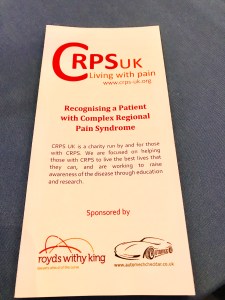
This is a key area for clinicians and our ability to recognise the likelihood that a person could develop CRPS. In honing the awareness and skills, this can only get better, which would translate into less suffering. Jumping ahead to the last part of the day, CRPS UK launched their new information leaflet that specifically targets the lack of knowledge and understanding.
The morning rolled on as we were treated to performances from the CRPS pop-stars. A gig typically gets going with the headline act at the end of a day of progressively bigger bands taking the stage. We started with a ‘main event’ as Lorimer Moseley entered the room via a video link.

Lorimer’s urine

Having shown off about his white, urine coloured wine as he described it, Lorimer gave us a typically witty yet informative talk. Always entertaining, LM is equally sharp in his observations from data, thereby keeping a firm foot in science. Admirably, he emphasised one of the often neglected aspects of being human in these situations — bias. Our declarations when speaking set the scene and let the audience know who we are (a bit).

The focus of Lorimer’s excellent work is certainly the brain. He has a way of transmitting the information in such a digestible way that most presenters would pay for a few of his (brain) cells. Together with the ability to make the listener feel on a par, this makes for easy listening whilst looking at some dots on a graph. I would not make head nor tail of those dots, but LM makes it engaging and everyone comes away knowing what they mean as well as an insight into the rigours of doing science well.

If there was a criticism it would be about the focus on the brain rather than the person. However, it is up the the clinicians and therapists to gather the presented information from the different speakers and form a bigger picture. Regular readers will know that my beliefs (and there will be bias in these of course) sit with the whole person approach, which is why Tim’s (Beames) talk softened the blow of data by bringing the human element to the room.

Tim and I have emerged from a similar place and whilst we will have our unique take, our interests lie in the person and that person learning to reduce their suffering. We both know that people can do this with the right ‘know-how’.

“The whole person approach is a must”

GMI (graded motor imagery) has been a big mover in CRPS. Tim was keen to point out that this is not a method to use in isolation, which I am sure everyone would agree with. In the physio world, over the years, there has often been the search for the recipe, the one treatment mode that will help. Littered with ‘gurus’, physio education has suffered as a result. I think and hope we are moving beyond this now. Integrated education when we share platforms with different disciples must be a way forward. Certainly in the Pain Coach Programme I want a range of clinicians and therapists so that we can create super teams with a shared vision, a focus on our strengths and each person knowing why they do what they do as a minimum.

Shock of the day goes to Robert Van Dongen as he described an approach whereby the person with CRPS receives hands on manual therapy that looks agonising. I say ‘looks’ because he treated us to a video of a foot and ankle being massaged and moved with audio. The noises coming from the recipient suggest it was not pleasant. The folk on my table who have CRPS winced and looked away, I felt something in my foot. It was provocative viewing! But, this is what is happening so we should discuss the treatment philosophy and work out whether it does have any long-term benefits. I am not sure. I will not be adopting this mode readers may like to know.

“Watching someone have a painful experience triggers real emotions and sensations in me”

The patients receiving the therapy were clearly motivated to undertake the programme. The short term pain of the treatment out-weighed the ‘pain’ of trying something else. There was a reward somewhere — maybe the relief of the heightened pain easing off! A key point here with a motivated patient is that they are likely to do well with any functional programme because they have prioritised and committed to taking actions in line with getting better. Would these people do equally well with a standard programme?

The shock wore off and we settled into a solid and well thought out talk on the team approach from Candy McCabe. I am into ‘teams’ and in particular ‘super teams’ so I was very pleased to hear Candy speak about some of the important principles. Great teams do great work but this necessitates a good leader, a vision, a recognition of individual and team strengths, engagement, and compassionate communication at the very least.

Bring a touch of the real world to the end of the day, we heard from two clinicians who described their experiences. Together with Victoria from Burning Nights, these stories brought the day to a conclusion as we moved from data, science and theory to what actually happens and the phenomenon of the lived experience. At the end of the day, it is this lived experience that is important. A person suffering CRPS, do they need to know about chemicals, brains, nerves etc, or do they need to know that they can be ok and that they can get better? For me that’s a no-brainer.

Whilst I agree that people must understand their pain (of course I do!), this is a practical knowing. The Understand Pain & Pain Coach Workshops deliver the knowledge, skills and know how, with the last element a vital part of the make-up. Without know-how, we don’t know. Not knowing results in fear, worry, and a hit and miss approach versus a knowing that leads to confidence, control and an outlook of being well.

Through the day there was acknowledgement that this is a difficult condition to treat and address for the person and clinicians. Traditionally thinking, yes this is true. But as with anything, if we start by saying how hard it will be, we are pre-empting. We are creating a lens of ‘difficultness’ through which we push everything else.

There is a choice to be had. What would happen if we used the lens of possibility and opportunity? We are designed to change and have inherent mechanisms of getting better. The offerings of a whole person approach tap into our potential as amazing human beings as opposed to focusing on a body area, a brain, a particular treatment approach. The reality is that we are all unique and hence there is no single way of dealing with a condition. And that is because we are not dealing with a condition, we are helping a human being overcome a challenge and how that manifests in them. The plea here then, is to stop trying to fit a round peg into a square hole. See things for what they are and address each person in the ‘personalised’ way that they need and deserve. I will write more on the ‘how’ of this subsequently.

So, with that all in mind, we move onwards into day 2……

If you would like to talk to me about UP and our positive work to drive social change, please do get in touch. UP delivers a range of workshops to deliver knowledge, skills and know how to overcome pain

You can email me here mailto:painphysiolondon@gmail.com
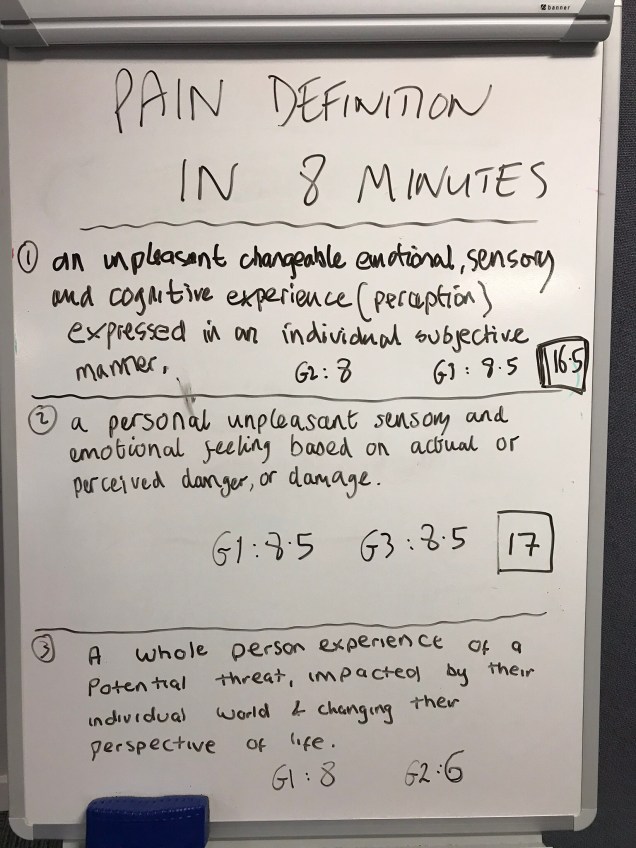
The big question: what is pain?

Society needs to understand pain

Thoughts from the Societal Impact of Pain Conference, Malta

Chronic pain is the number one global health burden. The approaches used for pain are not working. We are seeing the figures increasing over the years as more and more people suffer ~ 100 million people in Europe. Why? The main reason is the misunderstanding of pain that results in unnecessary investigations, treatments that don’t work and low expectations. The predominant thinking remains ‘biomedical’ both in terms of healthcare delivered and society’s expectations. Pain is not a medical problem. It is a public health, or societal issue. We are in it together, all of us. Even clinicians are patients!

Where do we start?

The UP enterprise has a purpose, and that is to change the way that society thinks about pain, hence Understand Pain. From the point of understanding comes new belief and commitment to reach one’s potential. The vision is a world where people understand pain so that the focus is upon the practices that foster a healthy, meaningful existence within the context of the person’s unique life. This emerges from co-operation between the person and the care-giver, working together to achieve results. This is the essence of Pain Coach, grounded in pain sciences, modern philosophy and strengths based coaching, delivering results based on what works. 

Pain Coach not only gives individuals unique knowledge and skills according to their needs, but also the all-important know how. I may have the best drill in the world, but without the know-how I will still make big holes in the wall as I try to hang a picture. The Pain Coach coaches the person to coach themselves to overcome pain. Conversely, interventions and medicines are ways to circumnavigate the problem. This is not to say that they do not have a role, however, the person learns nothing about facing it and transforming the experience and therefore will continue the loop of suffering. Only by learning about one’s existing patterns and creating new patterns in line with a vision of success, can the person overcome their pain. 

“What do you focus on?

What do you focus on? What language do you use to yourself over and over? What story do you tell yourself? You can make the decision to change your story. What can you control? Your attitudes, your thoughts, your day to day decisions are all yours. What do you do consistently? What do you think and embody consistently? That becomes the story of you. You can choose another script. That is the role of a coach, to help you realise and actualise your choices. To help you make decisions but ultimately you make them and commit to doing positive work to move in a desired direction. You decide the direction. 

What is pain?

Pain is part of the whole person state of protect. Pain is poorly related to any stage of injury, tissue damage or indeed tissue state. This is the common misunderstanding, that somehow pain and injury are the same or related. This is not the case and indeed Pat Wall, the father of pain science and medicine, stated this in his 1979 paper. Why then, is this not practiced as mainstream? This is one of the key messages for all. 

What are we protecting against? Initially there may be some kind of actual threat such as an injury or disease state, which is rightly interpreted by body systems as dangerous or potentially dangerous.  That’s the whole point of pain in a sense, to be so unpleasant that it compels us to take action. It is a vital survival mechanism without which we have no way to detect actual or potential danger. But, the pain itself remains part of a protect state in light of a perceived threat. 

“Pain is a feature of a state of protection

When pain persists, aka chronic pain (not everyone likes this term or wishes to be labelled as such), it means that a state of protect is persistently emerging as the prediction of threat frequents each day. The range of cues or patterns interpreted as potentially dangerous seems to widen and widen so that normally innocuous situations are deemed to be dangerous. This does not mean it has always to be at a conscious level as most of our biology operates in the dark, ie/ there are hidden causes. However, expectation does play a role in as much as when we expect something to hurt it does and often more as we prime, raise the threat level, predict to ourselves that it will hurt and guess what?

Pain is not a constant state. There is no constant state, instead we are continuously ‘updating’, dynamically exploring the environment with the aim of meeting our predicted needs. When a person suffers chronic pain, they will experience a number of episodes in a given day, with a more challenging day featuring more frequent or longer episodes, and a better day featuring less or shorter episodes. 

We are changing by design. No moment is the same. Like a foot placed in a river, it is never the same water that passes by. So change is not the question, rather which direction will you go? Which direction will you choose? To coach yourself towards a vision of success? To decide to commit to the practices of well-being? When people realise that they do have a choice it is empowering, inspiring and enabling.  We can decide to reach our potential. 

Who suffers chronic pain?

Work is being done to discover more about who would be vulnerable to a chronic state of protect. Players include genetics, past experience (e.g. prior pain, early life events) and gender. One way to think about this is that we are on a timeline, so nothing happens in isolation. When I stub my toe, my existing health and sense of well-being will influence how I react both ‘myself’ and my biology. In other words, if I am very tired and stressed, my experience will be very different to if I were relaxed and happy. Getting the person’s story is key to understanding the context. 

You can think of life’s events as priming. From day dot we are shaping ourselves and being shaped, right up until this moment. Every experience and everything learned sculpts us, our body manifest of the sum of all the things we have done and felt. The body systems that protect us evolve and become highly efficient, predicting that the causes of the sensory information mean that danger exists. Actively changing the sensory information with new practices, new habits and patterns of thought and action take us on different path. A path onwards in a chosen direction. Our attitude to change and belief in our own abilities are both key factors — and both can change in themselves!

“Pain is whole person — it’s not my back in pain, I am in pain. Me

The perception or experience of pain is coloured by many factors in that person’s life, including past experience, beliefs, context, environment, actions (current and predicted), emotional state, attentional bias (what I am focusing upon), other people and more. Pain undoubtedly emerges in the person. In other words, it is the person who suffers pain, not the body region where it is felt. Much like it is the person who is thirsty, not their mouth. 

In summary

  • It is the whole person who feels pain
  • Pain is part of the way we protect ourselves in the light of a perceived threat
  • Pain can and does change
  • Understand pain to change pain

UP and running again

A journey of courage

IMG_4611

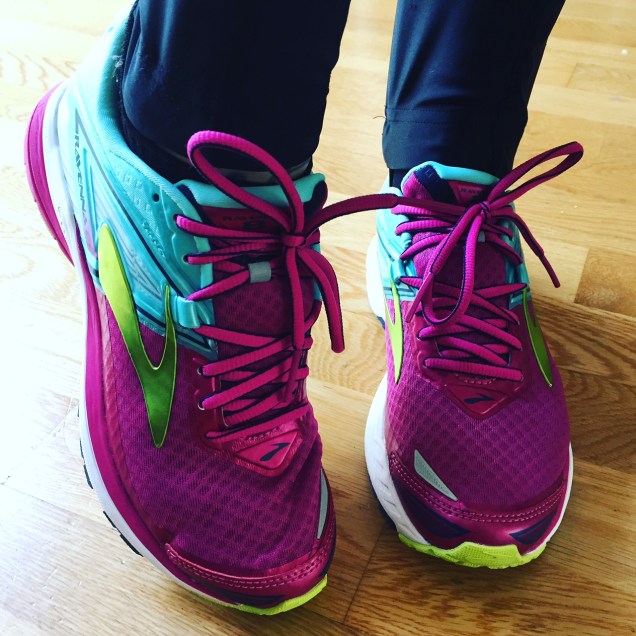
The London Marathon now in the past, we are focusing on the next run, The Royal Parks 1/2 Marathon in October. The details of the projects being co-supported with UP will be released soon, however we have two participants bravely embarking on the training journey. This is very exciting, but above all, full of meaning as they face the challenge of getting fit to run 13.1 miles. I know that they will do their best and we will be fully supporting them with a training programme and lots of positive encouragement.

Having just done the marathon for the first time, I know what it feels like to be thinking about running for long periods. However, the reality is never as bad as the thought, like most things. The actual run on the day is the icing on the cake, whereas doing one’s best along the way is success. This is a test. A test of oneself. And this is why it is such an incredible learning opportunity and a way to boost self-belief whilst improving physical health.

I will be documenting these two runners’ journeys and hopefully they will be writing their own blog entries. Sharing stories like this is inspiring to us all. We love to hear about and feel motivated by others’ achievements. They have achieved already by signing up. Now they can clarify their picture of success and think about what that looks like as they begin their experience!

RS


Every picture tells a story. Or does it?

Where is the pain on this picture? On any picture?

When it comes to pain and injury, the two are frequently thought of as synonymous. There is the well trodden path of reporting pain resulting in a scan or x-ray resulting in a finger pointing at an area on the picture as the culprit resulting in some pills, an injection or perhaps even surgery.

We must qualify the importance of eliminating serious pathology or tissue damage requiring intervention. Once this has been done, and in the vast majority of cases of chronic pain there are no serious findings, the focus must be on getting better.

However, the truth about pain and pictures is rather different. Yes, you may be able to see on an image an area of ‘wear and tear’, a disc bulge, a disc herniation, signs of osteoarthritis, or other visible changes. You cannot, however, see pain. So when pointing to one of these ‘structures’, how can you say that this is the cause of pain. How do you really know?

Consider a recent paper, ‘Systematic literature review of imaging features of spinal degeneration in asymptomatic populations’ (2015) that concluded: ‘Imaging findings of spine degeneration are present in high proportions of asymptomatic individuals, increasing with age. Many imaging-based degenerative features are likely part of normal ageing and unassociated with pain. These imaging findings must be interpreted in the context of the patient’s clinical condition’.

Further, Herzog et al. (2017) considered the experience of a person being scanned at 10 different centres over 3 weeks. They found a ‘marked variability in the reported interpretive findings and a high prevalence of interpretive errors in radiologists’ reports of an MRI examination of the lumbar spine performed on the same patient at 10 different MRI centres over a short time period’, concluding, ‘that where a patient obtains his or her MRI examination and which radiologist interprets the examination may have a direct impact on radiological diagnosis, subsequent choice of treatment, and clinical outcome’.

~ drugs and interventions do not teach us how to live or overcome pain

The poor relationship between pain and injury has been a known fact for many years. Pat Wall stated this as far back as 1979, with a huge number of studies and observations in the wake of this since. This poses the burning question, why does healthcare and society continue to ignore this fact and continue to concentrate upon a senseless search for a structure to explain pain? Followed by the question of why people are so often offered drugs and interventions as the way forward instead of understanding their and learning about how to overcome pain and live a life. Whilst drugs and interventions can have a role, they do not teach us how to live. Sustained change takes understanding and the practice of healthy skills.

Other pictures

Brain scan studies have given us incredible insight into the activity of this magnificent organ. It is like porridge. There are areas that show themselves to be ‘working’ during the experience of pain, and this has generated much excitement. Perhaps these are the ‘pain areas’, some people thought. Unfortunately not. There are no pain areas, and for that matter, there are no pain signals or pain nerves. Instead we have systems that play a role in our survival and protection including the nervous system, immune system and autonomic nervous system.

There are two important points here that we must consider. Firstly, we are more than a brain, much more. I am a whole person, embodying my thoughts, feelings, intentions, perceptions and actions. Secondly, as with MRI scans, we cannot point to an area and say that it is pain. We simply do not know how measurable and observed physiological activity becomes a lived experience. A question posed in an excellent paper by Krakauer et al. (2016) is this, ‘how does the brain lead to behaviour?’. Whilst the article is not about pain per se, they state ‘neural circuits do not feel pain, whole organisms do’. This thinking is very much in line with the very modern approach to pain: whole person.

Pain is subjective

The bottom line is that pain is subjective, only ever to be experienced by the person who’s pain it is, and never to be seen. A disc is a disc, not pain. A joint is a joint, not pain. A swelling is a swelling, not pain, etc. These observable features are objective and hence by definition not the same. It is essential that society and healthcare shift away from the predominant and existing thinking, and take on the facts of pain as we have known them for over 30 years.

Pain is a body, or whole person state. Pain is about protection when a threat or a danger is perceived, consciously or unconsciously. If the weight of evidence suggests danger, it makes sense that we should shift into a protect state. However, in chronic pain this state emerges because there is a frequent interpretation of possible danger. On the basis that we work on a ‘just in case’ basis, there might be a threat, so a protect state comes forth as the primary state just in case. You may argue the point that if there is nothing ‘wrong’, and that there is no damage, why should it continue to hurt? In short, this is because the interpretation based on what has happened before (priors) maintains a level of existing threat. You could ally this to habits and habitual responses based on what has happened before and expectations of what is likely to happen, again based on priors. More on this in a subsequent blog.

For now, to simply say again, pictures do not show pain.

RS


A grudge against pain

Forgiveness ~ Wanting a yes but getting a no and being at peace with it

funny evil gray striped cat

Frederic Luskin describes forgiveness as an ability to be at peace with what is, with the vulnerability that is inherent in human life. It is to accept this moment in a way that allows the next moment a chance. He talks about not getting what we want, receiving a ‘no’. In other words, I wanted a healthy life but I got a ‘no’ ~ I am not leading a healthy life, I am in pain. To forgive is to be resilient when things do not turn out the way we desire.

I feel that there are several themes here that are very relevant to pain. You may have already considered this point. If you have pain, you are getting a ‘no’ because that is not what you want: “I want to live a pain-free life. I got a no”. How are you dealing with that no? You can make the choice to forgive.

The effects of pain often result in many no’s because of limitations and avoidance: exercise, work, social events. The challenge is to turn this around, and forgiveness is one way in which you can, because you have the choice. We all need to realise the choice we have and how they can result in success, happiness and living well.

~ acceptance is not the same as giving up

To accept where one is and acknowledge one’s capacity or tolerance is a key first step. This is not, I hasten to add, giving in by any means. Instead, it is simply accepting your current status or fitness, to enable moving onward in your chosen direction. The opposite is to resist, resulting in continued frustration, annoyance and upset that does not take you in your desired direction. To do this we need to be able to forgive in the sense of forgiveness described above.

When we forgive another person, we are actively creating the conditions to move onward in a positive direction. This does not mean we condone the perceived offence or suggest that it was acceptable. Instead we acknowledge that we can move on, talk about the issue in such a way as to breed healthy learning. This is the case for both parties. Continuing to hold resentment on the other hand is distinctly unhealthy. ‘Who is holding the burning coal?’ one may say. How many festering resentments exist? How does this inform the next moment or next relationship? How many people act out with their current partners as if they were the prior abusive or unloving partner?

So who do we forgive for our pain?

The answer depends on who or what you blame. The continuance of habitual thinking, both consciously and subconsciously, about the causation of one’s pain often leads to further frustration, annoyance and upset. All of these states make it more likely that we suffer more and hence we are not heading in the right direction. These hooks, as Pema Chodron describes, are what trigger repeated patterns of thinking and emotion. But, we can become increasingly aware and practice skills to let go of such hooks and ease our suffering. Pema recommends developing your awareness when the ‘hook’ happens, taking 3 breaths and practicing letting go. This simple practice works, and gets easier like all things we focus upon and do the best we can.

~ take 3 breaths and let go

The pain that we feel is ours. It emerges in me, felt in my body, perceived within the context of my life to this point and relevant to this moment and the situation I am in. Pain is all about protection and often ‘just in case’. When we have an injury, pain is a vital survival mechanism that motivates action to promote healing. However, pain is poorly related to the amount of tissue damage, instead representing a body or whole person state of protection. It changes the way we think, feel and act, which is useful in the acute scenario. This becomes less useful as time goes on, as healing progresses and as we try to resume normal activities. In many people, despite the healing, the protective state continues to kick in as the body systems detect possible danger, based on learning or what has happened before. Pain itself become the problem.

Whom or what we attribute the blame for your pain then becomes the subject of our forgiveness. Here are Luskin’s 9 steps:

  1. Know exactly how you feel about what happened and be able to articulate what about the situation is not OK. Then, tell a trusted couple of people about your experience.
  2. Make a commitment to yourself to do what you have to do to feel better. Forgiveness is for you and not for anyone else.
  3. Forgiveness does not necessarily mean reconciliation with the person that hurt you, or condoning of their action. What you are after is to find peace. Forgiveness can be defined as the “peace and understanding that come from blaming that which has hurt you less, taking the life experience less personally, and changing your grievance story.”
  4. Get the right perspective on what is happening. Recognize that your primary distress is coming from the hurt feelings, thoughts and physical upset you are suffering now, not what offended you or hurt you two minutes – or ten years – ago. Forgiveness helps to heal those hurt feelings.
  5. At the moment you feel upset practice a simple stress management technique to soothe your body’s flight or fight response.
  6. Give up expecting things from other people, or your life, that they do not choose to give you. Recognize the “unenforceable rules” you have for your health or how you or other people must behave. Remind yourself that you can hope for health, love, peace and prosperity and work hard to get them.
  7. Put your energy into looking for another way to get your positive goals met than through the experience that has hurt you. Instead of mentally replaying your hurt seek out new ways to get what you want.
  8. Remember that a life well lived is your best revenge. Instead of focusing on your wounded feelings, and thereby giving the person who caused you pain power over you, learn to look for the love, beauty and kindness around you. Forgiveness is about personal power.
  9. Amend your grievance story to remind you of the heroic choice to forgive


Finding peace is a skill. There are many reasons why life can be turbulent. Choosing to create the conditions for peace by being aware of your habits, or hooks, and letting go results in a happier existence. Together with the skills of wellbeing, such as acts of generosity, noticing positive emotions as they arise, learning to pay attention, and resilience to name a few, this forms a healthy way onward. We can enjoy the good times, appreciate each moment and face the inevitable challenges in life with insight, knowing that time will always pass like the water of a river. Forgiving is a way of finding peace by letting go.