Abstract
The motor imagery (MI) has been proposed as a treatment in the complex regional pain syndrome type 1 (CRPS-1), since it seems to promote a brain reorganization effect on sensory-motor areas of pain perception. The aim of this paper is to investigate, through an integrative critical review, the influence of MI on the CRPS-1, correlating their evidence to clinical practice. Research in PEDro, Medline, Bireme and Google Scholar databases was conducted. Nine randomized controlled trials (level 2), 1 non-controlled clinical study (level 3), 1 case study (level 4), 1 systematic review (level 1), 2 review articles and 1 comment (level 5) were found. We can conclude that MI has shown effect in reducing pain and functionality that remains after 6 months of treatment. However, the difference between the MI strategies for CRPS-1 is unknown as well as the intensity of mental stress influences the painful response or effect of MI or other peripheral neuropathies.
RS: having used motor imagery for many years, this is no surprise; however we do need to understand more about which techniques work best for whom
My name is Ellen Williams and I have had CRPS for 5 years. My CRPS story began 6 months after I had an arthroscopy on my left knee after a sporting injury. Being told I was suffering from an incurable disorder, which is also invisible to everyone apart from me, was a rather daunting prospect at the age of 15. For the first 2 years I was told that I had a good chance of it disappearing, as I was young and fit enough to “fight” it like it was some sort of infection. 18 months of intensive physiotherapy, on a weekly basis helped to a certain extent but not enough to click my brain back. When the physical physiotherapy stopped working, I began asking questions. My doctor was the one to give me the news I did not want, telling me that now it was unlikely to go for a long time, if ever. As a 17 year old, hoping to go to university, beginning to think of what the future it felt like nothing mattered anymore because I was never going to be able to live the “normal” future I had been planning since I was 10. Needless to say this was the first time I had got very depressed during my battle with CRPS. However this is when I began to see Richmond. He gave me and my family the answers we needed but had never been given before, that yes I may have to live with this disorder for the rest of my life but that does not mean that life cannot be as good as it was always going to be. Learning to manage my disorder has had its difficulties along the way however every bad moment was worth it when I look back at how much I have managed to achieve since the first time I saw Richmond. My family has been there the whole time, through the tears, pain and happier times however I have always wondered about how hard it is for them. I struggle to see my mum unwell so I cannot imagine how she feels having to see me in agony and knowing there is nothing she can do to stop it. The one piece of information I would give to anyone with CRPS is that it is not just the person who suffers, so if you cannot try for yourself, maybe try for the ones who love you. Needless to say I am now 6 months away from finishing my degree and am doing what I love on a daily basis. I am happy. I never thought I would be able to say that 3 years ago and that does not mean I do not have bad days, some worse than others however my daily life is happy and is “normal” for me.
Persisting pain pervades all aspects of life, thinking, feeling and doing. Pain affects decision making, with tendencies to avoid or sometimes overdo and lead to a flare up. This is very individual, and each person will have their stories to tell about fears, worries, beliefs and what they did.
The Pain Coach Programme gives the person knowledge about their pain and skills to make moment to moment decisions about what is best to think and do at any given moment. In effect, the Pain Coach is coaching the person to become their own coach! The person is with themselves at all times, and therefore needs the knowledge in order to make the best choice. And this choice is all about taking an action that takes you towards your vision of where you wish to be. Where you wish to be is in the answer to the question ‘why do I want to get better?’
One of the strategies I coach people with persistent pain is called UBER-M. Cheesy perhaps, but easily remembered. One of the first things we do in the Pain Coach Programme is to help the person understand their pain, this to reduce fear and increase engagement with what needs to be done to overcome pain. You cannot solve a problem unless you understand it. But it is not just telling the person about their pain, it must be a working knowledge that can be applied: what do I know, what can I do now that is wise and healthy? This is the ‘U’. And below are the others:
U – understand your pain
B – breathe (mindfulness, relaxation)
E – exercises (general exercise, specific exercises & training)
R – recharge (we need to have enough energy to engage with the programme, with others, at work etc)
M – movement is congruent with health, but you need to develop confidence to move
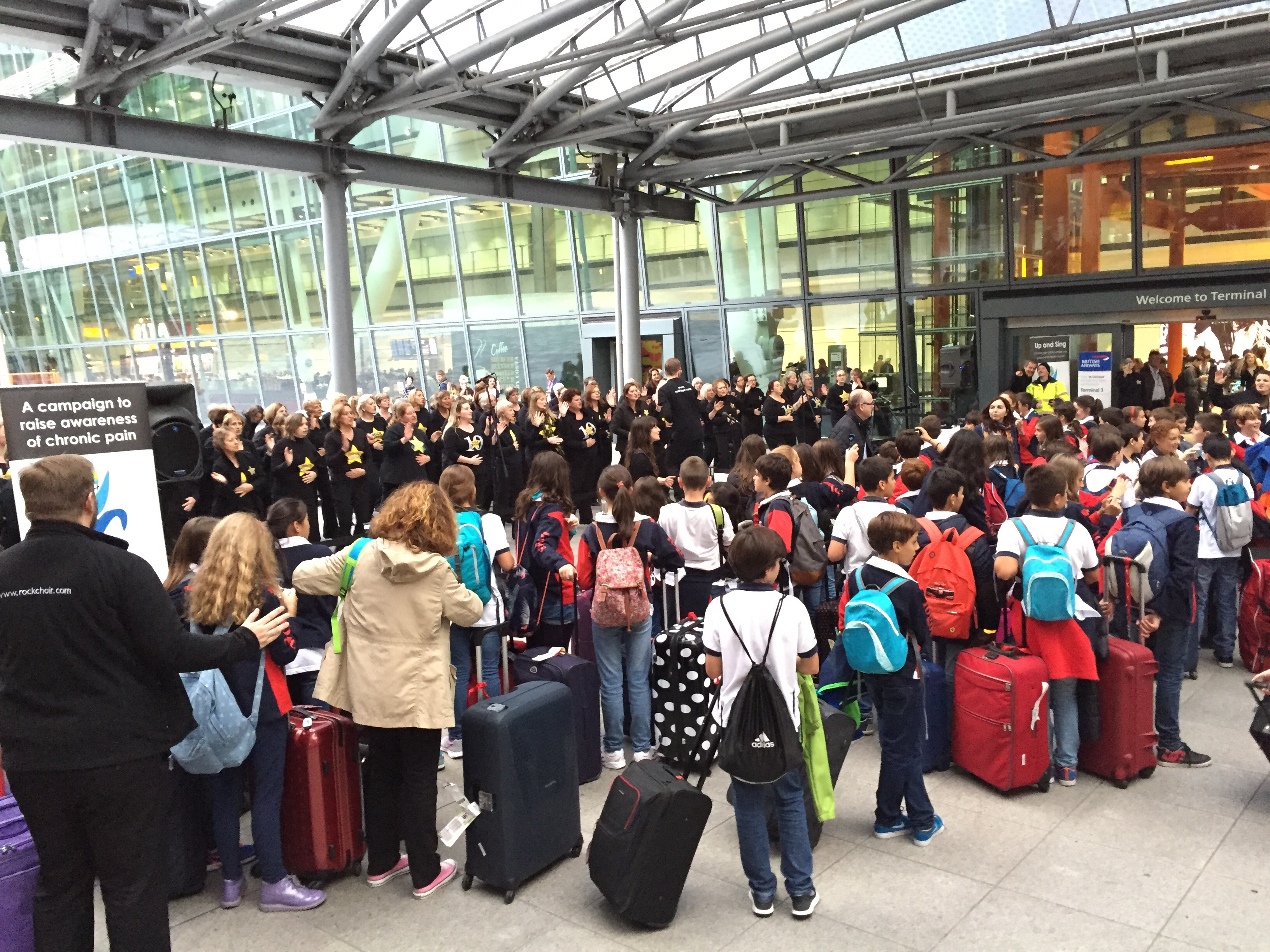
Click on the image for the video of Georgie at T5 for the UP event with Rock Choir — raising awareness of the global problem of pain at Heathrow. Look out for our Pain Coach seminar dates where you can come to learn about pain and what you can do to overcome pain.
Repetitive strain injury (RSI) is one of the office blights so it may seem. Of course you do not have to work in an office to suffer on-going arm or hand pain, or as some call it: WRULD (the rather clunky ‘work related upper limb disorder). You may have tennis elbow or golfer’s elbow, of course without playing either sport — then it should be lateral or medial epicondylalgia! Words aside, this is a big and costly problem for individuals who bear the brunt of the pain, symptoms and their consequential limitations, and for businesses that have employees on light duties or off sick. So how does typing cause an injury?
Well it may not. We are not really designed to be sat, hunched over a desk (as I am now I have just realised), poking away at small buttons, getting quicker and quicker so that we don’t even have to think about where our fingers are going in order to produce a document. The ‘noise’ created by all these small, precise movements of the fingers (signals flying up from the joints and muscles about movement, pressure, touch etc) can be difficult for the brain to gather into a tangible meaning. We start to develop different sensations, perhaps a change in temperature, some tingling, numbness or a sense of size difference (my hands are now warm and a bit tingly). If you interpret this as strange or mildly worrying because you have heard of RSI and you don’t want it because your job involves typing all day…..you can perhaps see how the worry and concern and vigilance and responses begin to amplify and amplify; this without any notable injury. However, the tension that builds, the stress responses that affect tissue health, the change in blood flow and nerve function when anxious, all impact and can create a threat value that is perceived as dangerous and hence the body systems that protect kick in — this may well mean some pain. And pain is useful and normal, even without a significant injury, because pain is a need state, motivating action: maybe I should take breaks? Perhaps I should type less at the moment? Maybe I need to work at changing my thinking about a situation that is making me stressed? Maybe I should start exercising regularly? Maybe I should seek some help and advice?
On-going use without adequate recovery can lead to an imbalance between tissue breakdown and rebuild, the natural state of change that is constantly occuring to all of us. The inflammation that results can of course add to the level of sensitivity or activate it, leading to aches and pains that can begin in specific locations but with time expand up and down the limb and even be noted in the neck and shoulder. This is not the spread of a ‘disease’, but rather the volume switch being turned up, meaning that increasingly normal stimuli (touch and movement, thought of movement, particular environments) can result in pain. Associations build with stimuli, and we get better and better at certain habits of thought and action that can perpetuate the problem — e.g./ avoidance, expectation, changes in movement, extra muscle tension unbeknownst to us.
There comes a point when the symptoms can begin so quickly that it becomes difficult to type, text, hold light objects and even gesticulate. This makes work life and socialising very challenging as well as frequently occupying much of our thinking, planning and our mental resources from the emotional impact. A comprehensive approach is needed to change direction and begin recovering, from wherever your start point. Certainly if you are feeling a few aches and pains that are becoming more frequent, you would be wise to seek advice. Or if you are struggling, then the right treatment and training programme can help you to resume meaningful activities.
Due to the biology of RSI, like all persisting pains, being upstream in the main, i.e. away from where the pain is felt, any programme must address this as much as improving the health of the tissues locally with movement and use (gradually). Once you undertand your pain, you realise that pain is not an accurate indicator of tissue damage, and that there are many things you can do to take you towards a better life. Asking yourself why you want to get better gives you the answer as to where you want to be going; your direction. We need direction and then the know-how to get there, dealing with distractions on the way, so that we remain focused on the right thinking and actions.
You will have been successful before, using your strengths (e.g./ concentration, empathy, dedication, motivation) and values. Using these same strengths and values to perform the training and to think in the right way leads you to a better outcome. What are your strengths and values? The exercises, training and treatment are all straight-forward, but their effectiveness is impacted upon by the way you think about your pain and your life. There are many factors in your life that are affecting your pain: e.g. tiredness, stress, anxiety, people, places. Understanding these and your pain puts you in a position to make changes and groove healthy habits and in so doing take the focus away from pain and worrying about pain to the doing and enjoying and living. There is only so much you can attend to in a passing moment, so why not focus on the good stuff? And if you are in pain, you can learn how to create conditions for ‘pain-off’ over and over whilst you get healthier and fitter generally as well as specifically training to resume meaningful activities: common problems are typing, texting, carrying etc.
This is an insight into modern thinking about pain and how to overcome pain. We understand so much more and this knowledge is ever-expanding. Passing this knowledge to you with practical ways of using it to overcome pain is our role, and treating you with techniques that calm and ease symptoms whilst you get fitter and stronger.
After today’s huge success once again, we know that we are on the right path. The support from the members of Rock Choir and the public was incredible, demonstrating that people recognise the scale of the problem. They also acknowledged that the situation is changeable, and we will certainly be driving this change with both our messages at events and with the Pain Coach seminars. Pain Coach is an approach to persisting pain that incorporates the latest pain sciences, the latest thinking in pain and strengths based coaching for successfully overcoming pain and resuming a meaningful life — watch out for the dates. This is all about the individual understanding their pain and knowing what action to take at any given moment to take them towards the life they envision.
Here are our immediate objectives that we are now working upon:
Achieving charity status
Pain Coach seminars for people suffering persisting pain and their carers
Pain Coach seminars for clinicians and others who need to understand pain (e.g. lawyers, human resources, occupational health, managers within business)
The next events that will always include music and song; simply because it makes us feel great!!
Our aim is to develop and mature UP, widening our net gradually as we support and educate society about pain and how we can go about changing and overcoming pain. If you would like to help us grow, please do get in touch: upandsing@gmail.com
We will announce Pain Coach dates and the next event very soon. Please tell your friends and colleagues about us and ask them to join our journey — a fun way of delivering a serious message and taking definite action.
We had a fantastic day at T5 London Heathrow today with around 800 Rock Choir members singing out for UP. There were some memorable moments as favourite songs were performed to passengers and staff as they walked through the corridor of melody between the opposing choirs, including a rugby team and a school tour, both of whom joined the spirit of the occasion. Here are some clips from the today:
Yesterday The Basingstoke Gazette published an article about the UP event tomorrow at Heathrow (Sat 24th October 2015). We are very excited about this second huge sing-song as the members of Rock Choir get ready to belt out the tunes all day at T5, London Heathrow. We will be filing the event and sharing the footage after the event, so you won’t miss out on the fun.
Welcome to my brief guide to pain. Pain is an enormous topic, drawing upon many disciplines and fields, similar to the study of consciousness. Whilst putting together my thoughts to answer the question ‘what is pain?’ I soon realised that it was going to be a lengthy piece, and only for those who had the time and inclination to bear with me. Regular readers of my blog at Specialist Pain Physio will be familiar with the importance of understanding pain (hence UP!! and @upandsing) as the start of changing and overcoming pain, particularly persistent pain. Now it is obvious why we called our campaign UP | understand pain — because when you do, you’ll realise that it can change when you take action, and that is what Pain Coach is all about.
So here’s my brief guide to pain in bullet points:
What is pain?
Here are some facts but not all (we will always discover new facts, and I will update accordingly):
This is my recent thinking on pain: “Pain is the conscious experience of a need state, others being hunger and thirst, felt by a person in a particular area of the body in respect of a perceived threat (that may be conscious or subconscious, or both), not separate from the context of the moment, the environment, prior experience, predicted experience, the social circumstance, current biological state, health, thoughts, feelings & emotions”.
Pain is a vital survival device, without it we do not live as long or as healthily.
Pain is part of the way we protect ourselves alongside changes in movement, body sense, thinking, emotions, perceptions of the environment, planning, anticipation, attention.
Pain is how we protect ourselves in the face of a perceived threat. When our body systems detect danger, actual or potential, there is a need to protect and this includes pain in the area that is perceived to need such protection — consider that the sum of sampling our body tissues, organs, systems (they sample themselves as well), plus the sum of the environment, plus the results of sampling the brain (what do I know, where am I, what are my beliefs, what have I done here before, what has worked, how am I feeling etc) leads to what we experience in any given moment; and if the sum of all of these inseparable characteristics of being alive represents some kind of threat, then we will change our behaviours and experience pain. For the mathematicians:
(what is happening in my body + what is happening in the environment + what I know + what I do not know I know) right now = (my reality in this moment) that is always passing
It is poorly related to the extent of the injury or tissue damage.
It hurts and ‘I’ feel it in my body (or where my body used to be or should have been, in the case of phantom limb pain).
It is ‘I’ who feels pain, not my body; I hurt, much like I am thirsty and not my mouth
When I feel better, my pain feels better (because I feel pain).
Pain involves many body systems — always the nervous system, often the immune system, plus the autonomic nervous system, the endocrine system and the sensorimotor system.
There is no pain system, there are no pain signals. There are systems that detect changes and presume threat that requires attention and action; pain compels us to do something to make it go away, both in how we think and what we do.
Pain is influenced by how we are feeling, how we think about it, where we are, who we are with, what we have been doing, what we are doing, what we may do, how tired we are, how much attention we put on the pain and our expectations to name but a few.
We can only feel pain now, in the present moment. Our memory of the pain experience is unreliable, and whilst we may recall that we were in pain several days or weeks ago, we cannot remember that actual feel of the pain with any accuracy. Like any experience, pain happens in the moment but is hugely flavoured by the way we think about it. For example, if we are anticipating that something will hurt, such as getting up from a chair, then it usually does and more due to the expectation priming our systems that protect. If we have pain under certain circumstances, an association can develop so that the next time the context arises, protection kicks in, including pain.
Next time….what sorts of things can we do to overcome pain?
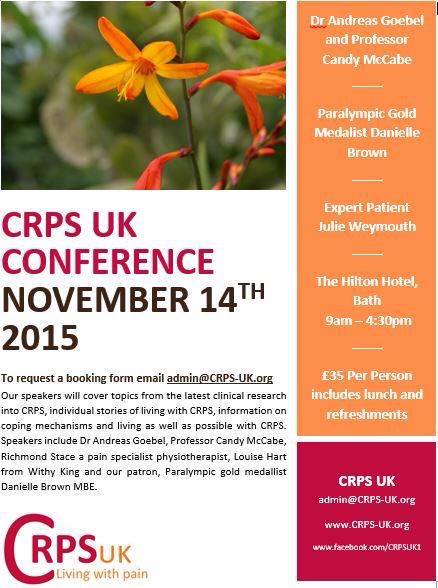
Here’s a quick reminder about the CRPS UK Conference that is coming up on 14th November in Bath, when there will be some fascinating talks from leaders in the field — see the flyer for details and booking.
I will be discussing practical elements of blending pain science and philosophical thought within a coaching model, a concept that I term ‘Pain Coach’, accompanied by Georgie from UP and Jo Moffitt who will both be sharing their experiences of CRPS. Our session aims to show you how we can go about changing pain and resuming a meaningful life with the right thinking and action, based on understanding pain.
The CRPS UK conference will be on the back of our next UP event, which is on Saturday at T5 London Heathrow, where an even bigger choir will be singing out all day to raise awareness of the problem of pain. We will be filming the event and putting out the footage so that you can enjoy the music — music being such an uplifter.

 My name is Ellen Williams and I have had CRPS for 5 years. My CRPS story began 6 months after I had an arthroscopy on my left knee after a sporting injury. Being told I was suffering from an incurable disorder, which is also invisible to everyone apart from me, was a rather daunting prospect at the age of 15. For the first 2 years I was told that I had a good chance of it disappearing, as I was young and fit enough to “fight” it like it was some sort of infection. 18 months of intensive physiotherapy, on a weekly basis helped to a certain extent but not enough to click my brain back. When the physical physiotherapy stopped working, I began asking questions. My doctor was the one to give me the news I did not want, telling me that now it was unlikely to go for a long time, if ever. As a 17 year old, hoping to go to university, beginning to think of what the future it felt like nothing mattered anymore because I was never going to be able to live the “normal” future I had been planning since I was 10. Needless to say this was the first time I had got very depressed during my battle with CRPS. However this is when I began to see Richmond. He gave me and my family the answers we needed but had never been given before, that yes I may have to live with this disorder for the rest of my life but that does not mean that life cannot be as good as it was always going to be. Learning to manage my disorder has had its difficulties along the way however every bad moment was worth it when I look back at how much I have managed to achieve since the first time I saw Richmond. My family has been there the whole time, through the tears, pain and happier times however I have always wondered about how hard it is for them. I struggle to see my mum unwell so I cannot imagine how she feels having to see me in agony and knowing there is nothing she can do to stop it. The one piece of information I would give to anyone with CRPS is that it is not just the person who suffers, so if you cannot try for yourself, maybe try for the ones who love you. Needless to say I am now 6 months away from finishing my degree and am doing what I love on a daily basis. I am happy. I never thought I would be able to say that 3 years ago and that does not mean I do not have bad days, some worse than others however my daily life is happy and is “normal” for me.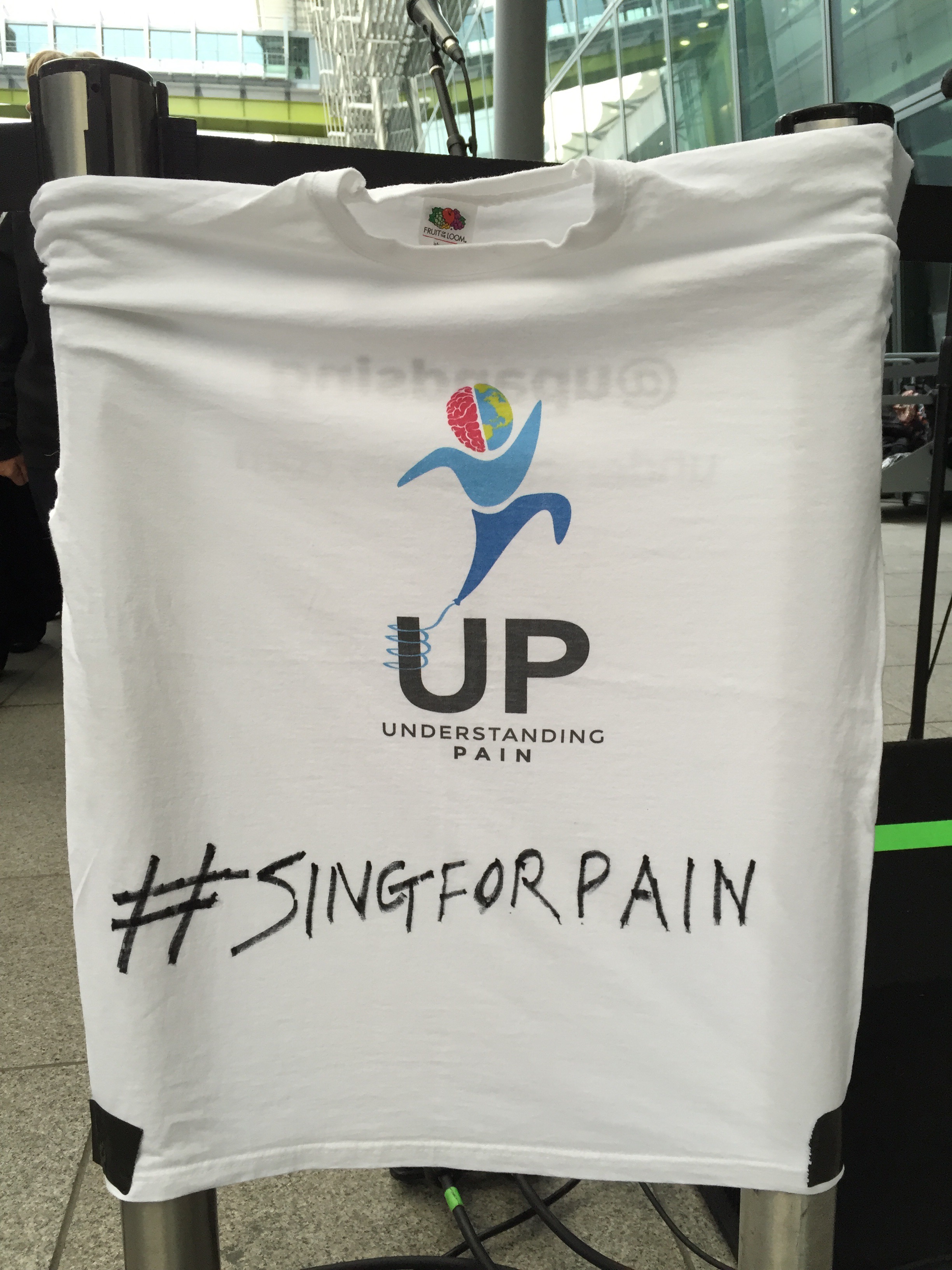



 understand pain