
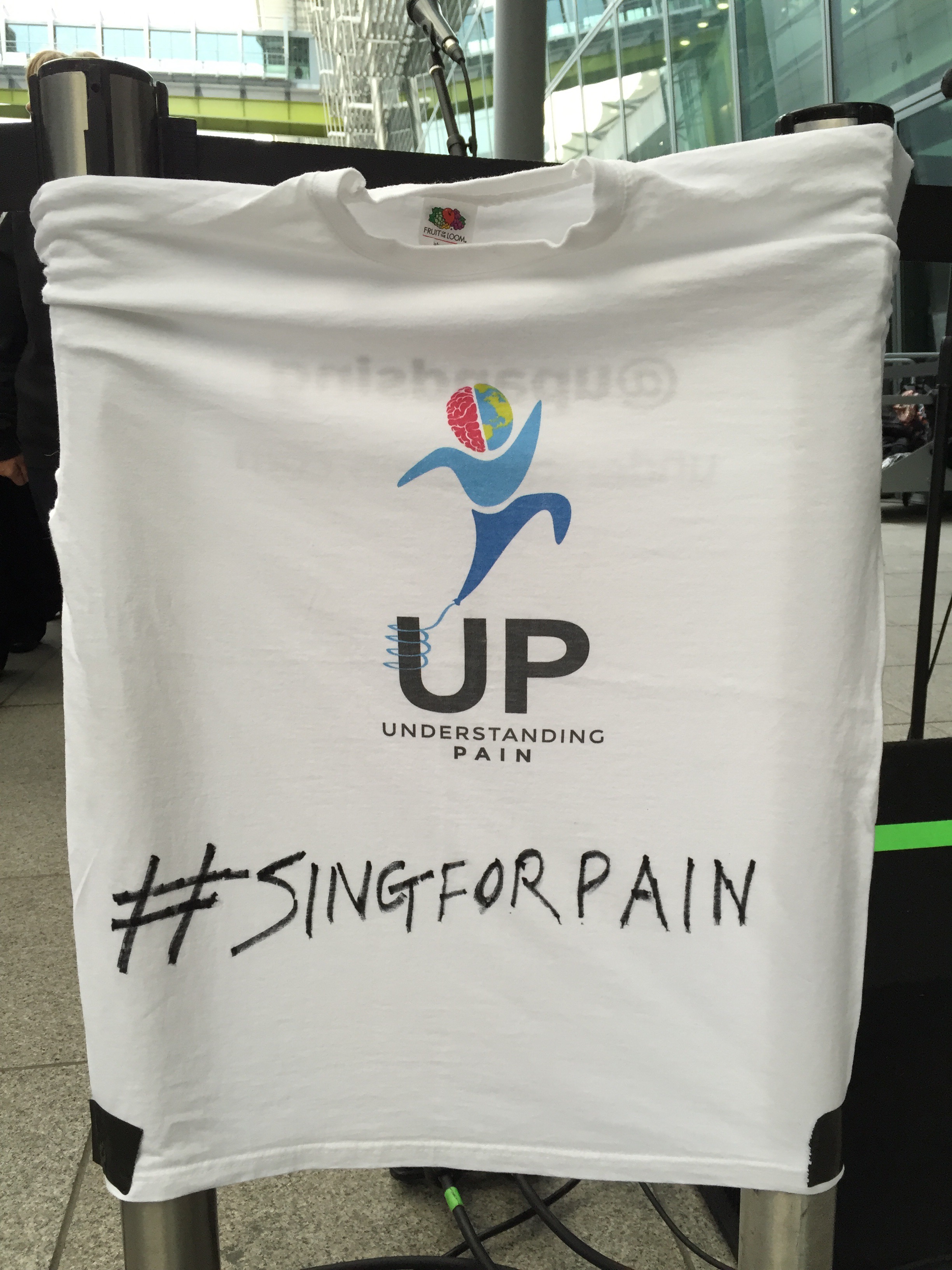
Come and follow us on Twitter @upandsing with #singforpain


Come and follow us on Twitter @upandsing with #singforpain
Tomorrow is the 3rd #upandsing event at London Heathrow T5, so if you are working or passing through, come and see the show! There will be hundreds of singers once again, entertaining the passengers and staff at Terminal 5 from 1030 in the morning until 4pm. It’s a marathon sing song! And what better way to be uplifted than with music and singing.
The last two events in 2015 were both great fun days as well as opportunities to deliver the UP | understand pain messages. Chronic pain is one of the largest health burdens. The personal suffering and cost to society is enormous, yet many people do not realise this fact. Recent figures suggest over 40% of the population suffer pain beyond 3 months, a timeline that is deemed to be chronic. Whilst there is much more to it than a timeline, this figure demonstrates the enormity of the issue that needs addressing urgently.
One of the main contributing factors to this vast problem is the misunderstanding of pain in society. The UP campaign seeks to address this aspect by providing the latest information and thinking about pain. One of the reasons for raising money is to develop this website into a great resource for people across the world to access freely and learn both about pain but also what they can do to change their pain. Further, we are in the process of designing the best structure to apply for charity status so that we can fundraise to support important research and studies into pain so that understanding and treatment continues to advance.
Pain touches so many people across society. Pain is indiscriminate. It does not receive the attention or funding in proportion to the scale of the issue. So many conditions involve painful experiences and so many people experience pain without any serious condition, together making for the seismic impact that it has across the globe.
Please share and spread the word! Follow us on twitter @upandsing and see us on Facebook (a new page has been created today!). You will see picture and videos uploaded from tomorrow’s event, so you can share these with friends and colleagues, knowing that pain can and does change when you understand it and know what you can do.
 Persisting pain pervades all aspects of life, thinking, feeling and doing. Pain affects decision making, with tendencies to avoid or sometimes overdo and lead to a flare up. This is very individual, and each person will have their stories to tell about fears, worries, beliefs and what they did.
The Pain Coach Programme gives the person knowledge about their pain and skills to make moment to moment decisions about what is best to think and do at any given moment. In effect, the Pain Coach is coaching the person to become their own coach! The person is with themselves at all times, and therefore needs the knowledge in order to make the best choice. And this choice is all about taking an action that takes you towards your vision of where you wish to be. Where you wish to be is in the answer to the question ‘why do I want to get better?’
One of the strategies I coach people with persistent pain is called UBER-M. Cheesy perhaps, but easily remembered. One of the first things we do in the Pain Coach Programme is to help the person understand their pain, this to reduce fear and increase engagement with what needs to be done to overcome pain. You cannot solve a problem unless you understand it. But it is not just telling the person about their pain, it must be a working knowledge that can be applied: what do I know, what can I do now that is wise and healthy? This is the ‘U’. And below are the others:
U – understand your pain
B – breathe (mindfulness, relaxation)
E – exercises (general exercise, specific exercises & training)
R – recharge (we need to have enough energy to engage with the programme, with others, at work etc)
M – movement is congruent with health, but you need to develop confidence to move
For more information Pain Coach | Specialist Pain Physio Clinics London | Richmond Stace

Click on the image for the video of Georgie at T5 for the UP event with Rock Choir — raising awareness of the global problem of pain at Heathrow. Look out for our Pain Coach seminar dates where you can come to learn about pain and what you can do to overcome pain.
 Yesterday The Basingstoke Gazette published an article about the UP event tomorrow at Heathrow (Sat 24th October 2015). We are very excited about this second huge sing-song as the members of Rock Choir get ready to belt out the tunes all day at T5, London Heathrow. We will be filing the event and sharing the footage after the event, so you won’t miss out on the fun.
Welcome to my brief guide to pain. Pain is an enormous topic, drawing upon many disciplines and fields, similar to the study of consciousness. Whilst putting together my thoughts to answer the question ‘what is pain?’ I soon realised that it was going to be a lengthy piece, and only for those who had the time and inclination to bear with me. Regular readers of my blog at Specialist Pain Physio will be familiar with the importance of understanding pain (hence UP!! and @upandsing) as the start of changing and overcoming pain, particularly persistent pain. Now it is obvious why we called our campaign UP | understand pain — because when you do, you’ll realise that it can change when you take action, and that is what Pain Coach is all about.
So here’s my brief guide to pain in bullet points:
What is pain?
Here are some facts but not all (we will always discover new facts, and I will update accordingly):
Next time….what sorts of things can we do to overcome pain?
Richmond Stace | Pain Coach & Specialist Pain Physiotherapist
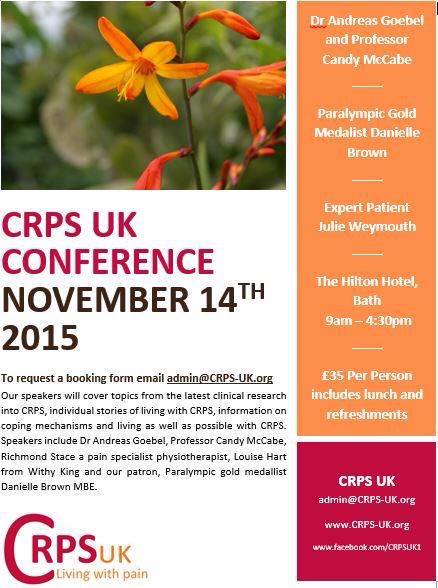
I was very pleased to be asked to speak at the CRPS UK Conference this year (see flyer for information). A few years ago I went to the conference and gave a talk about some of the latest approaches to treating CRPS, and since then there has been further progression in both thought and action. I will be looking at these developments as well as sharing the stage with Georgie who will be telling her story.
Those familiar with the UP mission will know that we are delivering messages about pain based on fact and science, illustrated by people’s lived experiences that demonstrate how individuals can move forward and live meaningful lives by understanding their pain and knowing what they can do at any given moment.
One of the problems with treatment and ‘sessions’ with healthcare professionals is that the actual face to face is limited in comparison to the rest of the time. Hence the individual must develop their knowledge and skills so that at any moment they can make a clear decision about the best course of action in terms of how they think and what they do. Arising as a solution to this problem, I developed Pain Coach, which is not only about coaching the individual in pain but also guiding them to become their own coach. This is a blend of the latest neuroscience, thinking in pain and a strengths based coaching model — we all have strengths and values that we have used in our lives, and we can use these for success with our painful problems as well.
The CRPS UK conference will be off the back of the UP event at Heathrow in October, so we shall be full of beans! UP uses singing and music to deliver our messages, but I leave that to Georgie and her choirs — I will not be subjecting you to my tones!
Hope to see you there!
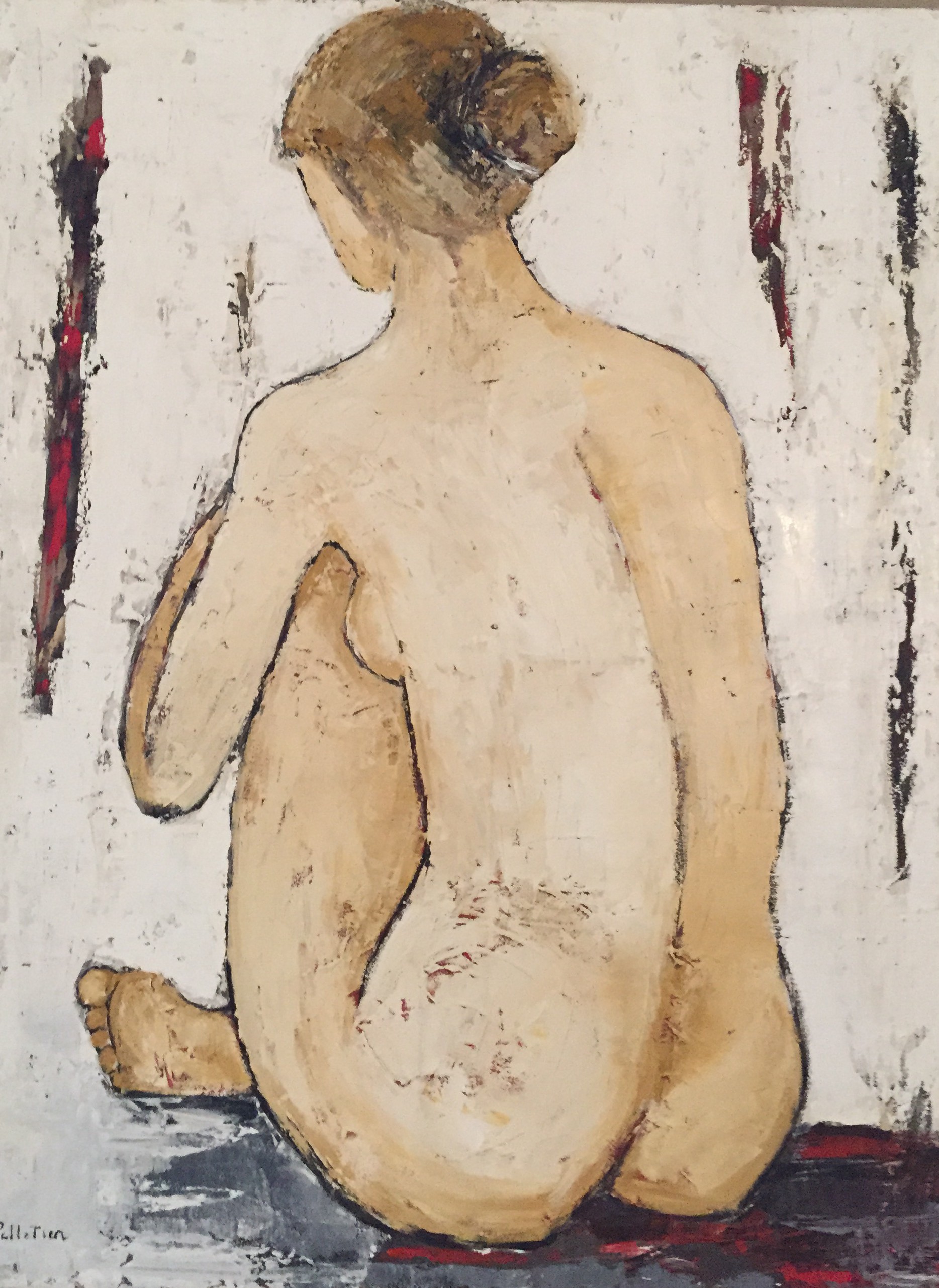 Vulvodynia is a painful condition, often exquisitely so, located in the vulva, which is the skin surrounding the vagina. Usually unexplained, this troubling condition can arise seemingly from nowhere, interfere with intimate relations and hence attempts to conceive. Vulvodynia is also known as a functional pain syndrome–these are painful problems that lack a pathology of note that explains the extent of the pain and include irritable bowel syndrome, fibromyalgia, TMJ dysfunction, migraine and pelvic pain. Functional pain syndromes are often concurrent with hypermobility, anxiety and depression, a further common character trait being perfectionism and a tendency for the person to be hard on themselves thereby creating a cycle of chronic stress.
The pain of vulvodynia is often very localised and triggered by direct contact. Naturally this occurs during sex and touch, but sometimes sitting position can bring on the pain. As with any sensitisation, there is a primary location of pain but there can also be a secondary area surrounding that is due to central nervous system (and other systems) involvement. Suspected vulvodynia or other pains in the pelvis should be assessed and examined by a gynaecologist as a first step before beginning treatment, and by a consultant who knows and understands both the condition and the impact — Miss Deborah Boyle at 132 Harley Street.
With vulvodynia often being part of an overall picture of sensitivity, it means that there is a common biological adaptation that is upstream of the range of seemingly different conditions (the functional pain syndromes). As soon as the individual understands that pain is not an accurate indicator if tissue damage, but rather a reflection of the perceived threat and prioritisation by the body-person, there is a realisation that the pain can change. Pain can change because perceptions can change as we take on board new information and consequently think and act differently, creating new habits. The new habits set the conditions for on-going and sustained change that includes overcoming pain.
We have limited attention and hence can only be aware of certain amount of stimuli in any given moment. If pain is consuming much or all of your attention and consciousness, then this is all that is happening in that moment, with all other possible experiences being disregarded–it is a matter of prioritisation. When the perception of threat is reduced by a constructive thought or action, the pain moves out of our attention span and we become aware of other thoughts, feelings and experiences. How we respond to pain is unique and learned through our lifetime right up until that point; all those bumps and bruises as a child, how our parents reacted, more serious injuries or illnesses and the messages we received from doctors, teachers and other ‘big people’, then through adult life, moulding our beliefs about ourselves, the world, health and pain each time we feel it. The sum of all this activity, most of which we are unaware of, sets up how you respond to the next ache, pain or injury, blended of course with genetics. It seems that some people are genetically set up to be more inflammatory, meaning that responses to injury are potentially more vigorous and go on for longer. Understanding this means that the right messages and treatment can be given, thereby appropriately addressing the injury or pain. One of the big problems is that this does not happen, and the explanations are structural and based upon the body tissues. This ignores the fact that we have body systems that protect and these systems have sampling mechanisms in the tissues and organs but largely exist elsewhere–e.g./ nervous system, autonomic nervous system, endocrine system, sensorimotor system, immune system. We have to go upstream as well as improve the health and mobility of the local tissues.
Going upstream is vital in overcoming vulvodynia, and this is where the Pain Coach Programme works–this is my part of the treatment programme. You may also choose to work with a women’s health physiotherapist who will work more locally. So what is the Pain Coach Programme?
The Pain Coach Programme is a a blend of the latest neuroscience of pain with a strengths based coaching approach to success. Understanding your pain and that you have the biology and strengths to overcome your pain is a vital start point. You have been successful in the past using these strengths, and you can do so again by drawing on these characteristics and using them to develop your health in terms of how you think and act. Overcoming pain is all about resuming a meaningful life, engaging with activities and people as you want to, in a way that allows you to flourish. The Pain Coach Programme provides you with the knowledge and skills that you need to in effect become your own coach, moment to moment making clear decisions that take you towards your vision of how you want to live. This alongside treatment and specific training to develop normal movement and a healthy body-mind. The skills you learn also help you to fully engage in life, whether this be at home, at work or at play.

Richmond has published some pain related articles in recent time in addition to the regular blogs. The links to all are below:
Functional Pain Syndromes | In Touch Autumn Edition 152 (2015)
Whiplash review 2015 (Bone & Joint 360, 2015)
Shoulder Pain (Manual Therapy, 2013)
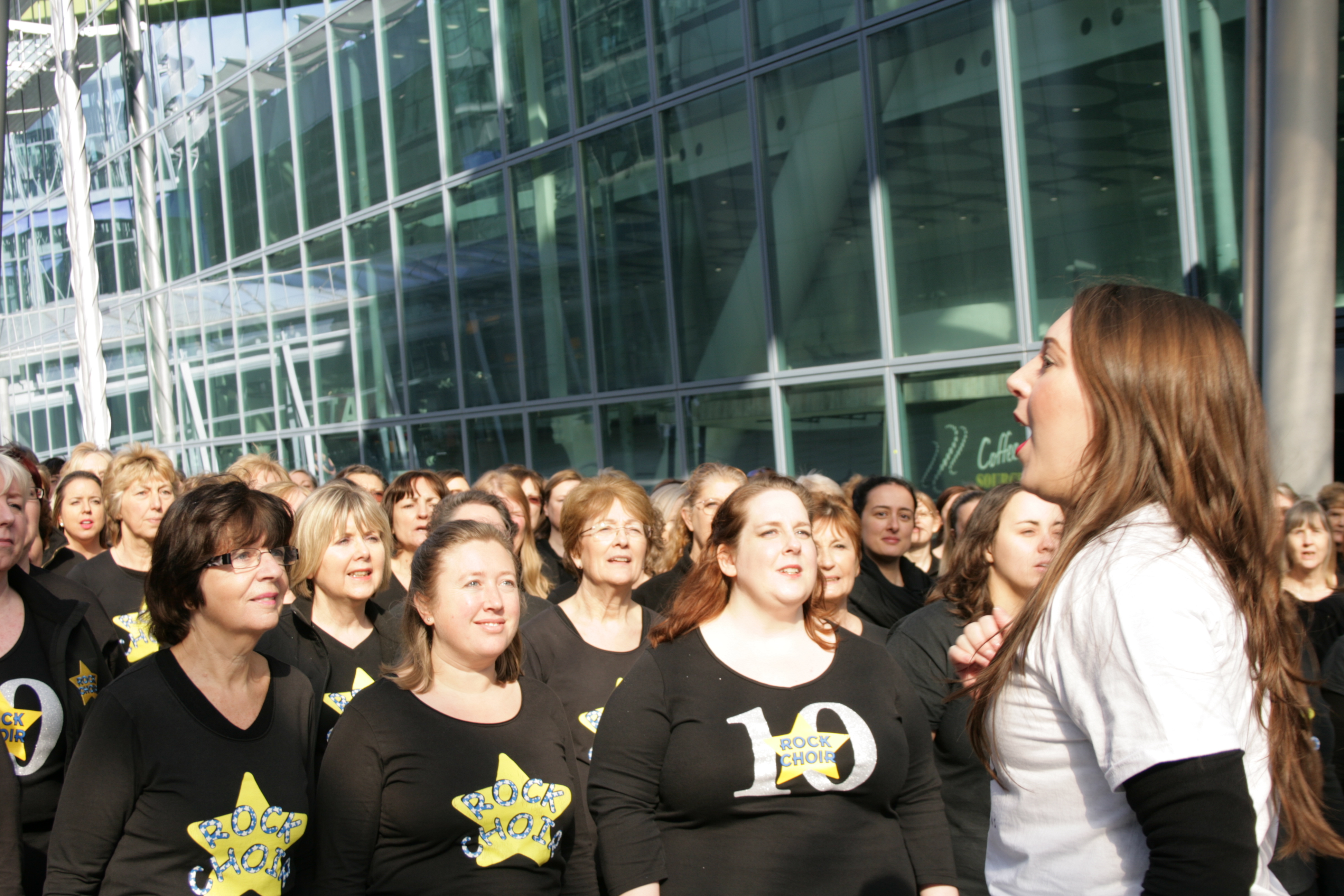 At UP | Understand Pain we are really excited to have our second event following the enormous success of the launch in March. We had hundreds of choir members from Rock Choir, singing out for UP at Heathrow where passengers and staff enjoyed the entertainment at Terminal 5. This time we are going bigger and better with more choirs and a non-stop sing-a-thon, the only breaks being brief talks about UP, what we are doing and why.
UP was formed by Georgie and Richmond earlier this year to raise the awareness of the huge problem of pain (back pain is the number one global health burden; in the top 10 of global health burdens we have back pain, neck pain, osteoarthritis and headaches), and that there is plenty that we can do to change and overcome pain, this to resume a meaningful life as exemplified by Georgie herself and many others.
One of the biggest problems regarding pain that we face as a society, is the misunderstanding of pain itself. It is still thought of and treated as if the body structures are to blame, i.e. where the pain resides is where the issue exists and where treatment must be directed. Pain science has been telling us for years, since Pat Wall and Ron Melzack shifted our thinking, that there is much more to consider as the biology exists elsewhere in the main. The latest thinking blends science and philosophy to consider pain as a whole person, lived experience — e.g. in the case of back pain, it is the person who feels pain, not the back; much like hunger, it is the person who feels hungry and not their stomach.
Our current priorities are:
* more information to follow on Pain Coach workshops.
If you are travelling through Terminal 5 or work at the Terminal, come and see us and show your support!! If not, don’t worry as we are filming the event so that the World can see the performances and hear our messages.
Onwards and UPwards….. please spread the word and ‘like us’ on Facebook and follow us on Twitter @upandsing
 understand pain