
Richmond to run London Marathon 2017 for UP and CRPS UK

I am very excited to announce that I will be running the London Marathon this year jointly supporting UP and CRPS UK.

Please support us here by donating whatever you can spare to help reduce suffering

CRPS UK is a registered charity that is focused upon supporting people with complex regional pain syndrome (what is CRPS?). CRPS is often a terribly impacting condition characterised by intense pain and accompanying symptoms that reach into every aspect of the person’s life. Having received little attention, CRPS is gradually becoming more recognised, thanks in great part to the on-going work of the team at CRPS UK.

Georgie, my co-founder at UP, came to see me several years ago with CRPS and therefore at UP we were thrilled to team up with CRPS UK. CRPS has been a condition that I have studied for many years, and having worked with many people living the condition, personally I am honoured to represent CRPS UK and UP in this way, hoping to make a contribution by raising money to allow the work to go on.

Chronic pain is the number one global health burden. Think about all the conditions that hurt and cause pain. This is not just musculoskeletal pain, but all pain — cancer, gastrointestinal disorders, headaches, migraines, pelvic pain, heart disease, post-surgical pain, infections, inflammatory disorders! If pain was understood globally, by society, by individuals, we would know what we can focus upon to overcome the problems and live as best we can in a meaningful way. At the moment this is not the case. There is still a focus on the tissues and pathology as an explanation, but this is not the case. We have known for years that pain and injury are poorly related, and that there is much more to pain to know and work with to create the conditions for change.

This is what we aim to do at UP and CRPS UK. Pain is a public health problem affecting millions in many different ways: home life, relationships, social activities, work to name a few. People need to know the ways in which they can navigate these issues and move onward. The money you give will directly support projects and initiatives to reach this end where we hope to influence the policy makers and healthcare providers, but in essence to help the individual ease his or her suffering.

Thank you.

Richmond
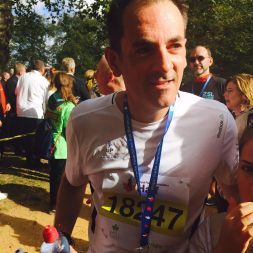
 

We have done the run!

up-maraThe Royal Parks 1/2 marathon today (9th October 2016) ~ we have done the run!

Team UP completed the run around the Parks and London today to raise awareness for UP and money to launch our campaign. It was a great success!

The Team: Richmond Stace, Jonathan Vickers, Peter Brown, Chris Mutch & Ann Dunmall

On a beautiful morning, we completed the course in good time. Ann even sang in the Rock Choir performance on the main stage!! Awesome!

We were very well supported by Jo, Lucy, Lucy H, Georgie, Mark and of course the volunteers and staff. A big thanks to Sally!

This success means that we will do it again. And again. The #upandrun will now be one of the ways in which we continue to raise awareness through exposure and conversations with people and other charities. UP will support runners in the UK and beyond by funding their place and supplying a running shirt while the runner raises money for UP. So if you want to run for us, get in touch ~ upandsing@gmail.com

You can still support us here: upandrun

And now for the feet to go up!

UP supports research into pain

cropped-screen-shot-2015-10-21-at-08-20-53.pngOne of our main objectives is to raise money to support vital research that will make a significant difference to the way in which pain is understood and treated. Such research is underway here in the UK. This is both exciting and necessary in moving forward our thinking so that we can have a significant impact on the global problem of pain.

Mick Thacker has been an enormous influence upon my work and beyond, and in fact I blame him entirely for my obsession with understanding pain! I still recall the lecture he gave when I had my ‘aha’ moment, realising that there was a way forward. Not looking back since, there have been incredible steps forward to where we are now. Mick has had a huge impact upon so many people over the years and this continues. We have a lot to be thankful for and I am grateful for the opportunity to support the work he describes below. I believe that this research is by far our best opportunity to truly understand pain.

‘We propose an interdisciplinary programme of research that focuses on a new approach to pain based on the Predictive Processing Framework (PP) set out by Profs Andy Clark, Jakob Hohwy, Anil Seth and Karl Friston. The main feature of this proposition is that pain arises from circular influences that link the body (including a brain) with the world. This approach sees pain as an action-orientated perception that attempts to both identify and alleviate/limit the potential causes of actual, potential or ‘imagined’ danger to the self. We believe that this approach will extend well beyond the current bio-psychosocial model.

Working closely with philosophers and neuroscientists we will reframe our current understanding of pain using models of PP and will marry empirical based experiments into nociception with current philosophical perspectives. We plan to use these newly acquired perspectives to propose and plan a series of empirical studies that examine pain from the perspective of PP. The direction of these studies are likely to employ many different approaches across the (cognitive) neurosciences including human psychophysics and neuroimaging as well as the development of modelling paradigms involving artificial neural networks and related techniques allowing us to fully understand and evaluate pain and it’s impact on the person.’

Mick Thacker PhD. MSc. Grad Dip Phys. Grad Dip MNMSD. HPC. FCSP.
Senior Consultant AHP (Pain) Guy’s & St Thomas’ NHS Foundation Trust &
Centre for Human and Aerospace Physiological Sciences. King’s College London.
Pain Section, Neuroimaging. Institute of Psychiatry. Kings College London.
Adjunct Senior Research Fellow, School of Health Sciences. University of South Australia.

Some strong words about pain

Here are some strong words about pain because this is what drives the UP | understand pain campaign. Chronic pain is the number one global health burden — it costs us the most and then consider the personal cost and suffering endured by each individual. We are not just talking about musculoskeletal pain (e.g., back pain, neck pain, osteoarthritis etc.) but all pain: headaches, migraines, pelvic pain, irritable bowel syndrome, cancer related pain, pain related to conditions such as diabetes, heart disease, lung disease and all the other situations in which we hurt and can continue to suffer.

Traditionally the search for the reasons for pain consisted of looking for a pathology, an injury or other structural explanation in the body. The biomedical model needs something to find, something to see with the naked eye or on a scan. Pain can never be seen.

Pain is the ultimate example of a conscious experience, and conscious experiences are built by the individual based on a number of factors that are biological, psychological and sociological. Typically it is the biology that is focused upon with some psychology, which means that the biopsychosocial model purported for some years now, is not really used except in name.

The reality is that you cannot separate these dimensions. How is psychology not biological or sociological? How is biology not psychological? It makes no sense to divide what is a lived experience, a first person experience that embraces the unification of thoughts, perceptions and actions. Fortunately for society, there is a model that is most likely to be able to reflect this unification and the research needed to test the model is going to be supported by the UP campaign (charity-to-be).

As society has evolved so has our pain. Chronic pain is a societal phenomenon — on certain parts of the world, back pain did not exist until the concept was introduced by modern healthcare. That is a societal issue, not a medical issue. And by this regard, society needs a shift to support a new understanding of pain to relieve that very society of this on-going pain problem. This is not a medical problem. As time moves away from the initiation of the pain experience, it shifts rapidly towards the need for a sociopsychological model — what does the person in pain need to understand? What do they need to do? How do they engage with their family? How do they engage with their work? How do they communicate their pain? What actions do they need to take day to day to get better?

This is a public health problem that needs addressing as such. It is not dramatic to say that world leaders and policy makers need to be having conversations about the health problem that costs the globe the most and taking action now. It is absurd that the main reason for seeking help, the vehicle taking people to healthcare is frequently pain. How much formal training do healthcare professionals receive?

The passion behind UP | understand pain emerges from the absolute need for an enforced change from the bottom up. Society needs to be instrumental in the change for its own good and so this is where UP is taking the campaign. To the people. The voice of the people to enforce the necessary change.

This weekend UP has a team at The Royal Parks 1/2 Marathon, raising funds that will be the foundation for all that is described above. So join us and spread the word as we raise the profile of this problem into the consciousness of society for action to be taken now.

Join us on Twitter @upandsing using #upandrun

What research is UP supporting?

Pain being hugely complex and one of the greatest examples of a conscious experience means that we have many questions to answer. This includes an understanding of pain biology, pain psychology and the social dimension. Whilst all are important, it is the unification of these that is the lived experience, the phenomena of pain. This is what we must ultimately understand so that we can have a true working knowledge of what is going on and what we can do about it.

Hence we need a model that can deliver this depth of understanding and a basis for action. We are fortunate in that such work is going on as we speak, and it is this work that UP will be supporting. The yield will be the practical application of our knowledge about pain so that individuals can really know what they can do to move forward and overcome their pain. Such knowledge will also inform healthcare practice from the outset when a person presents with a pain problem — those initial messages are vital; they must be right as they often set the scene.

Chronic pain is the number one global health burden, which means that millions are suffering. This can change. This must change. This is the reason for UP.

Please support us in our mission and come and see us at The Royal Parks run on Sunday 9th October: http://www.justgiving.com/crowdfunding/understandpain

We are on twitter @upandsing and our hashtag for the run is #upandrun

RS

Why are we running in The Royal Parks 1/2 marathon?

DSC_0179Not long to go now! The day’s events look great fun, so do please come and see us so we can tell you (once we have our breath back!) what UP is all about and why we are raising money.

In short, UP is all about changing how people and society thinks about pain by delivering the right messages based on the latest science of pain. The widest reach comes via the internet and so we are working on a great website resource for all those who need to understand pain — people suffering, those affected by chronic pain and those delivering the care. We are also raising money to support contemporary research into pain, in particular the use of a practical model that explains pain and provides a way forward for people on a day to day basis.

Chronic pain is the largest global health burden, and most people don’t even know that!

Please come and support us! There are 5 of us running ably supported by Jo and Georgie. Georgie will also be performing with Rock Choir on the main stage.

Follow us on Twitter @upandsing where the hashtag will be #upandrun

If you would like to donate to the campaign, please click here and know that you are contributing towards a new movement to reduce global suffering.

Hope to see you there! Look out for the logo: cropped-screen-shot-2015-10-21-at-08-20-53.png

UP for Hyde Park half marathon

On 9th October an UP team will be running the Hyde Park half marathon, raising awareness for the understand pain campaign. Following three successful singing events at Heathrow, we are moving forward by applying to become a charity. This will create a structure that enables us to fundraise so that we can support our work in delivering the right messages about pain, empowering individuals and educating health professionals globally.

The overarching aim of UP is to reduce the suffering endured by millions across the globe. A shift in thinking so that pain is understood will enable change in the right direction, whereby we live in a world where pain is not feared but instead addressed in the right way. This means we use the right language and communication with people, focus on their needs, listen to their story, respect their experience and create a way forward with the person. Not only does UP promote change in the right direction by understanding pain, but also how we can go about this in a compassionate fashion.

Here are our immediate plans:

  1. to create a brilliant website full of high quality content that will help individuals and society to understand pain and what can be done.
  2. to promote individual’s understanding of their pain and what influences their pain so that they can be empowered to overcome their problems and lead a meaningful life.
  3. to raise money to support a research project that will further our understanding of pain so that treatment can improve.

Much more to come!

The team are really looking forward to the half marathon, which will be a lot of fun. I think that there maybe a few surprises in the crowd to look out for and a few competitions on the day. Keep following us and share with friends, colleagues and family. We need your support so that we can spread the word and reach as far and as widely as we can!

If pain

IMG_2528If pain was understood, there would be less suffering.

If pain was understood, the right messages would be given from a young age, sculpting behaviours based on what needs to be done.

If pain was understood, there would be no fear about it.

If pain was understood, we would focus on what we can do to feel better.

If pain was understood, it would be known that listening deeply is the first step to help someone transform their pain.

If pain was understood, it would be known that understanding pain changes pain.

If pain was understood, there would be an enormous amount of money available for a better society.

If pain was understood, it would sit in the realm of public health and not medicine.

If pain was understood, there would not be the reliance on medication.

If pain was understood, what would the world be like?

— this is the mission of UP | understand pain; to globally change the understanding of pain, because put simply, the world would be a better place if pain were understood.

http://www.understandpain.com

Refresh and renew

seaRefresh and renew is one of the most important strategies that I teach individuals who have been suffering persistent pain. Within the refresh and renew there are a range of techniques that can be used dependent upon place, time and context, all of which are important ingredients making a whole. We are in no way separate from where we are, what we are thinking, what we are doing and what we are feeling. These are merely the conscious elements and of course there are the vast subconscious elements including our biology in the dark.

Being in pain is exhausting, usually added to by feelings of anxiety and concern. There can often be a cycle of pain and sleep disruption, one begetting the other as time moves on. It seems more and more probable that sleep is fundamental for our health, which is why creating the conditions for a consistent daily rhythm of activity and rest is vital. Most people know what it is like to ‘survive’ after a bad night’s sleep, but imagine the effect when this is on-going.

Refresh and renew is needed throughout the day by everyone. Every 90 minutes we may feel an urge to do something: move, take a few breaths (4-5 is good), have a healthy snack or a glass of water. This is certainly the case when one’s health is below par as we need to create the conditions for our biology in the dark to switch into health mode rather than survive mode. The person suffering persistent pain spends much of their time in survive mode as they are both consciously and subconsciously protecting themselves from perceived threats. Consider the person with back pain who walks into a room to survey for the closet chair, whether it is likely to be comfortable or if they will be able to have a conversation because their pain maybe too distracting. The thought processes, predictions, anticipations and expectations that are embodied, will prime the coming experiences. The good news is that creating new habits can change this routine for the better, beginning with being aware that this is what you are doing.

All the extra monitoring and thinking is tiring as you use your resources, along with imprecise and guarded movements that require more energy than normal. Too much muscle activity for example, has a huge energy consequence, which is why refresh and renew is so important through the day. Setting reminders and alarms can be effective in the beginning, but as the new habits take hold and the internal messages become second nature, you increasingly make the choices that orientate you to getting better; your desired outcome.

Facial Pain

Yesterday I spent the day in Leicester and Northampton seeing several people suffering facial pain with a colleague who has been working in the field. All pains are unique to the person, however, I feel that there are some particular features of facial pain, which are similar to those of facial dystonia. Identifying these shared characteristics has guided treatment and training techniques that aim to improve sensorimotor function as part of adapting and restoring a sense of self.

The loss of the sense of self is a significant part of suffering in my view. People describe how the pain or dystonia impacts upon their lived experiences and their choices, narrowing both. This means that they are not doing what they wish to and hence do not feel themselves as they feel they should. A shift has occurred, part of which is constructed via the ‘physical’ sense of the body. Of course we have a unified experience of ‘me’ including the sense of the body, a sense of a past, a projected future and the inner dialogue that strings it together.

We literally face the world with our face and hence anything that affects our perception of how we are doing this will impact on how I feel, think, the actions I take and perceptions I perceive. There is a spectrum: a red spot through to jaw dystonia — something visible to others that makes us second guess what they may or may not be thinking. Quite easily this can mean we avoid going out or seeing people. The isolation that ensues then gathers momentum, affecting us on many levels including genetically.

In cases of facial pain there may be no clear and consistent visible signs such as the involuntary movements of facial dystonia, however there are often habitual posture and facial expressions — tension, attempts to relax by opening the mouth, rubbing, speech impediments. When we are in pain, our body sense can be different, the perception of the environment can be different, the way we plan changes and our emotional state is one of protection, as is that of our underlying biology. Whilst this is vital for survival when there is an actual threat (an injury or pathology), in most cases of persistent facial pain and other pains, there is no significant injury. The pain is a habitual response to perceived threats that increase in number with time via learned responses and expectations. Things that would not normally pose as a threat now do, including the way we think about ourselves and the world. With a sensory system detecting changes internally and externally, in survive mode we can be jumpy and very responsive.

Facing the world with a painful face is challenging. Understanding pain is the first step to steering change in a desirable direction — how do you want to be? When the person understands that pain can and does change, and that they are the drivers of that change, then new habits can be formed — new habits of thought and action that are practiced over and over to create the right conditions. Likewise in dystonia, the practice of new habits to change the way in which the sensorimotor system is working but integrated with training that addresses the influences upon this system — e.g./ the environment, thinking, emotion. Learning to recognise and let go of unhelpful and distracting inner dialogue, focusing on what you can do, noticing positive emotions and how you evoke them, re-training sensorimotor function, gradually doing more normal and desired activities are all part of a comprehensive programme based upon the neuroscience of pain and using your strengths to be successful.