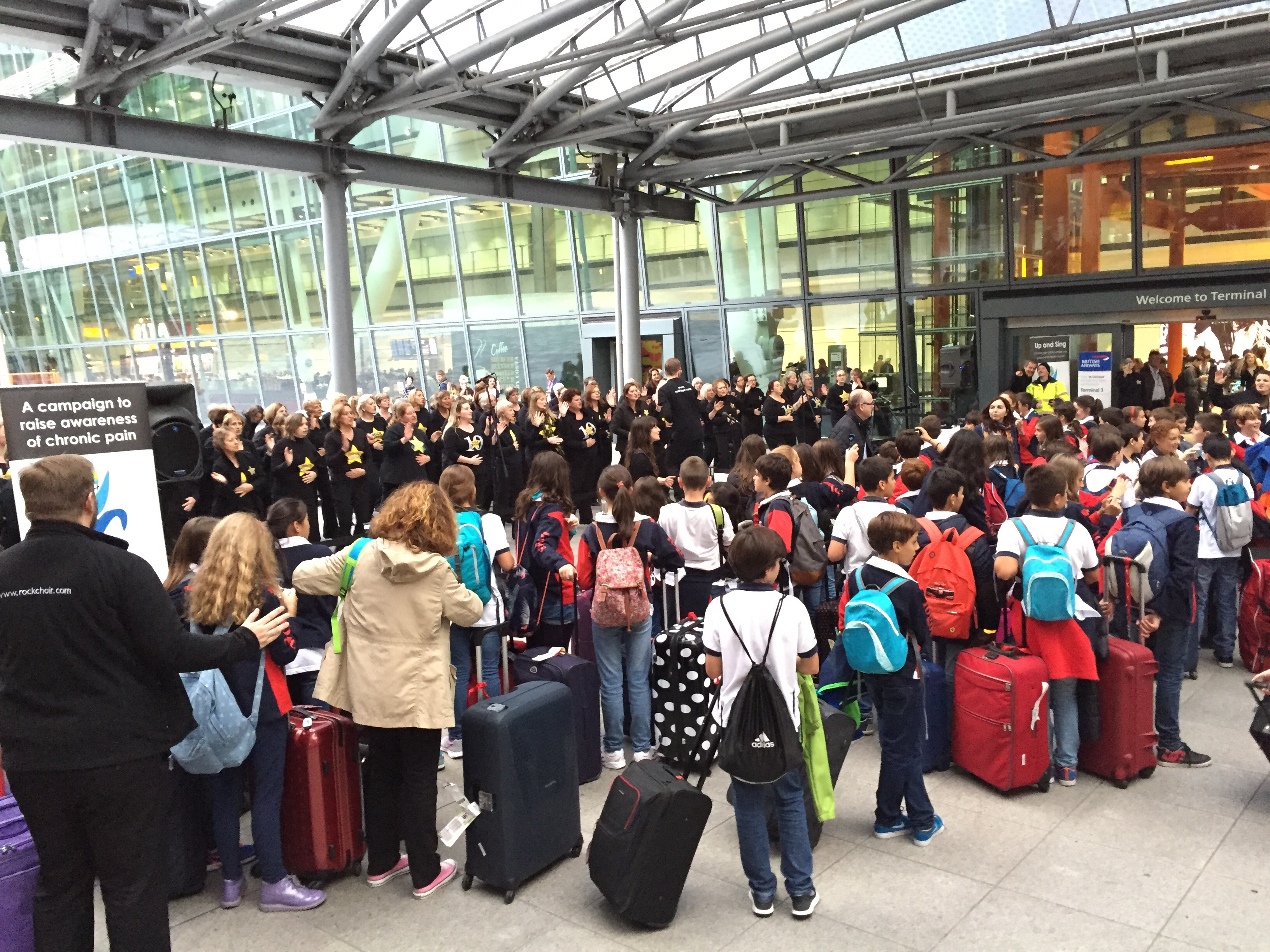
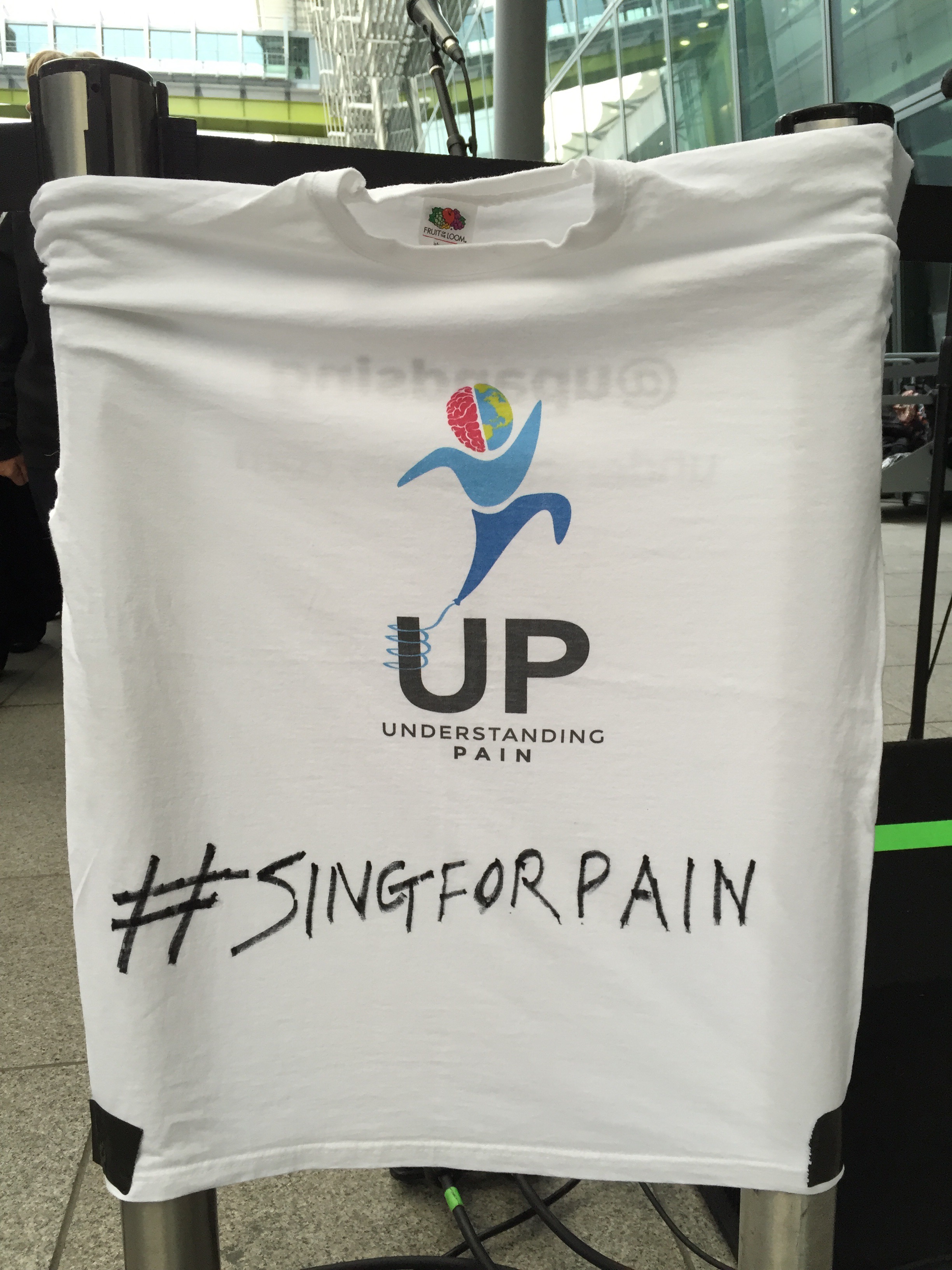
Click on the image for the video of Georgie at T5 for the UP event with Rock Choir — raising awareness of the global problem of pain at Heathrow. Look out for our Pain Coach seminar dates where you can come to learn about pain and what you can do to overcome pain.
Understand Pain
What’s next for UP?
After today’s huge success once again, we know that we are on the right path. The support from the members of Rock Choir and the public was incredible, demonstrating that people recognise the scale of the problem. They also acknowledged that the situation is changeable, and we will certainly be driving this change with both our messages at events and with the Pain Coach seminars. Pain Coach is an approach to persisting pain that incorporates the latest pain sciences, the latest thinking in pain and strengths based coaching for successfully overcoming pain and resuming a meaningful life — watch out for the dates. This is all about the individual understanding their pain and knowing what action to take at any given moment to take them towards the life they envision.
Here are our immediate objectives that we are now working upon:
- Achieving charity status
- Pain Coach seminars for people suffering persisting pain and their carers
- Pain Coach seminars for clinicians and others who need to understand pain (e.g. lawyers, human resources, occupational health, managers within business)
- The next events that will always include music and song; simply because it makes us feel great!!
Our aim is to develop and mature UP, widening our net gradually as we support and educate society about pain and how we can go about changing and overcoming pain. If you would like to help us grow, please do get in touch: upandsing@gmail.com
We will announce Pain Coach dates and the next event very soon. Please tell your friends and colleagues about us and ask them to join our journey — a fun way of delivering a serious message and taking definite action.
We look forward to seeing you at the next event!
What a day!
We had a fantastic day at T5 London Heathrow today with around 800 Rock Choir members singing out for UP. There were some memorable moments as favourite songs were performed to passengers and staff as they walked through the corridor of melody between the opposing choirs, including a rugby team and a school tour, both of whom joined the spirit of the occasion. Here are some clips from the today:
A brief guide to pain – what is it?
Welcome to my brief guide to pain. Pain is an enormous topic, drawing upon many disciplines and fields, similar to the study of consciousness. Whilst putting together my thoughts to answer the question ‘what is pain?’ I soon realised that it was going to be a lengthy piece, and only for those who had the time and inclination to bear with me. Regular readers of my blog at Specialist Pain Physio will be familiar with the importance of understanding pain (hence UP!! and @upandsing) as the start of changing and overcoming pain, particularly persistent pain. Now it is obvious why we called our campaign UP | understand pain — because when you do, you’ll realise that it can change when you take action, and that is what Pain Coach is all about.
So here’s my brief guide to pain in bullet points:
What is pain?
Here are some facts but not all (we will always discover new facts, and I will update accordingly):
- This is my recent thinking on pain: “Pain is the conscious experience of a need state, others being hunger and thirst, felt by a person in a particular area of the body in respect of a perceived threat (that may be conscious or subconscious, or both), not separate from the context of the moment, the environment, prior experience, predicted experience, the social circumstance, current biological state, health, thoughts, feelings & emotions”.
- Pain is a vital survival device, without it we do not live as long or as healthily.
- Pain is part of the way we protect ourselves alongside changes in movement, body sense, thinking, emotions, perceptions of the environment, planning, anticipation, attention.
- Pain is how we protect ourselves in the face of a perceived threat. When our body systems detect danger, actual or potential, there is a need to protect and this includes pain in the area that is perceived to need such protection — consider that the sum of sampling our body tissues, organs, systems (they sample themselves as well), plus the sum of the environment, plus the results of sampling the brain (what do I know, where am I, what are my beliefs, what have I done here before, what has worked, how am I feeling etc) leads to what we experience in any given moment; and if the sum of all of these inseparable characteristics of being alive represents some kind of threat, then we will change our behaviours and experience pain. For the mathematicians:
- (what is happening in my body + what is happening in the environment + what I know + what I do not know I know) right now = (my reality in this moment) that is always passing
- It is poorly related to the extent of the injury or tissue damage.
- It hurts and ‘I’ feel it in my body (or where my body used to be or should have been, in the case of phantom limb pain).
- It is ‘I’ who feels pain, not my body; I hurt, much like I am thirsty and not my mouth
- When I feel better, my pain feels better (because I feel pain).
- Pain involves many body systems — always the nervous system, often the immune system, plus the autonomic nervous system, the endocrine system and the sensorimotor system.
- There is no pain system, there are no pain signals. There are systems that detect changes and presume threat that requires attention and action; pain compels us to do something to make it go away, both in how we think and what we do.
- Pain is influenced by how we are feeling, how we think about it, where we are, who we are with, what we have been doing, what we are doing, what we may do, how tired we are, how much attention we put on the pain and our expectations to name but a few.
- We can only feel pain now, in the present moment. Our memory of the pain experience is unreliable, and whilst we may recall that we were in pain several days or weeks ago, we cannot remember that actual feel of the pain with any accuracy. Like any experience, pain happens in the moment but is hugely flavoured by the way we think about it. For example, if we are anticipating that something will hurt, such as getting up from a chair, then it usually does and more due to the expectation priming our systems that protect. If we have pain under certain circumstances, an association can develop so that the next time the context arises, protection kicks in, including pain.
Next time….what sorts of things can we do to overcome pain?
Richmond Stace | Pain Coach & Specialist Pain Physiotherapist
CRPS UK Conference | November 2015
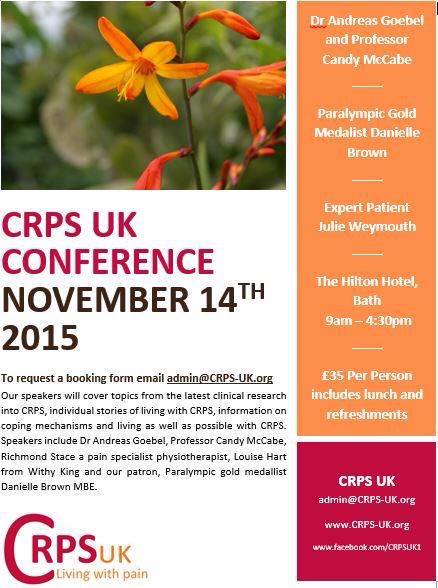
I was very pleased to be asked to speak at the CRPS UK Conference this year (see flyer for information). A few years ago I went to the conference and gave a talk about some of the latest approaches to treating CRPS, and since then there has been further progression in both thought and action. I will be looking at these developments as well as sharing the stage with Georgie who will be telling her story.
Those familiar with the UP mission will know that we are delivering messages about pain based on fact and science, illustrated by people’s lived experiences that demonstrate how individuals can move forward and live meaningful lives by understanding their pain and knowing what they can do at any given moment.
One of the problems with treatment and ‘sessions’ with healthcare professionals is that the actual face to face is limited in comparison to the rest of the time. Hence the individual must develop their knowledge and skills so that at any moment they can make a clear decision about the best course of action in terms of how they think and what they do. Arising as a solution to this problem, I developed Pain Coach, which is not only about coaching the individual in pain but also guiding them to become their own coach. This is a blend of the latest neuroscience, thinking in pain and a strengths based coaching model — we all have strengths and values that we have used in our lives, and we can use these for success with our painful problems as well.
The CRPS UK conference will be off the back of the UP event at Heathrow in October, so we shall be full of beans! UP uses singing and music to deliver our messages, but I leave that to Georgie and her choirs — I will not be subjecting you to my tones!
Hope to see you there!

Pain Articles & Blog

Richmond has published some pain related articles in recent time in addition to the regular blogs. The links to all are below:
Functional Pain Syndromes | In Touch Autumn Edition 152 (2015)
Whiplash review 2015 (Bone & Joint 360, 2015)
Shoulder Pain (Manual Therapy, 2013)