Pain the week before a marathon and during: what can you do?

And pain after 🙂

Pain before and during – what can I do?

With the famous London marathon coming up this Sunday, there are a few nerves in the air. That’s completely normal and part of the journey. As is excitement!

What’s the objective this week?

To get to the start line!

You may have heard of maranoia. All those thoughts, feelings and bodily sensations that can pop up the week before: am I ill? Have I injured myself? I’m so emotional etc etc. Again, all normal part of the journey.

You have put in the best training that you could over the past months. The day is the icing on the cake. The fun bit!

It is an amazing day. For me, because of the people—your fellow runners and the crowd. Each has a story.

Advice: immerse yourself in it! Take moments to look around and be present with what you are doing and what is happening.

Pain before

Some people will have pain that they are now worrying about. Especially if it has cropped up recently.

So here are a few insights that may help you. Then some ways to deal with pain during your run.

Have you actually injured yourself? If so, you can seek help and advice that may help you get through the day. Remember that you just want to get to the start line. As long as the injury is not serious, you may just get through it. Amazing what you can do by focusing on your purpose and why the marathon matters to you.

If the injury is significant in terms of tissue damage, it’s unlikely you will be able to take part. This is hard to deal with when you have put in all the effort. But remember, you have put in all the effort! The process offers invaluable learning about yourself and what you are capable of achieving. To choose not to run can be a wise yet tough decision. You can now focus on recovery and using your new knowledge and training history to shape a positive future in a different way.

Sometimes there is no significant injury but there is pain. That’s because pain and injury are poorly related and are completely different entities.

Maybe it is a minor tweak or simply a manifestation of a length training period. Whatever, it’s a message or information for you to act upon. Seeking advice to understand your pain is key.

Worry, concern and fear can all effect your pain. The pressure you put on yourself, the stories you are now telling yourself can create stress that amplifies the pain experience.

What happens if you use calming practices such as breathing, mindfulness and easy nourishing movements?

In many cases, the aches and pains are part of the maranoia experience. I typically feel achy and fluey, and notice various pains in the week or so before an event. It’s just what my body systems do.

In response, what can you do?

1. Keep moving, all within your window of tolerance (some aches and pains but essentially good experiences of movements): tapering runs, mobility, yoga etc.

2. Breathing, mindfulness, relaxation

3. Good fuel and hydration

4. Prioritise sleep

5. Minimise stress where possible—focus on what you can control and not what you can’t

6. Keep focused on your picture of success and the step you can take right now

7. You are creating the conditions now, in this moment, to maximise your chances of getting to the start line.

If you unsure, do seek help. Make sure who you speak to knows their stuff; ie/ expert in pain and running.

Pain during

Inevitable for most people, if not all.

Perhaps you have learned some strategies that you have practiced during your training.

There are many ways to handle pain during a marathon. Having a range of tools is important because at different times you’ll need different strategies. You can scroll through until you find the one that works in that moment.

Here are 10 examples.

1. Have a snack

2. Have a drink

3. Remember your purpose and the people you are running for

4. Create a mantra you can use, or several. You can write it on your hand.

5. Zoom out: reassure yourself that you are ok, then look ahead.

6. Zoom in: some people find that focusing on the pain brings an initial increase but then ease. Why? Because being open to the experience allows it to pass through.

7. Chat to a fellow runner

8. Listen to the crowd

9. As you are running along, imagine running smoothly and confidently

10. Focus on a part of your body that feels good

Bonus…. From Eliud Kipchoge….

11. Smile 🙂

Good luck from me! Onwards!
RS

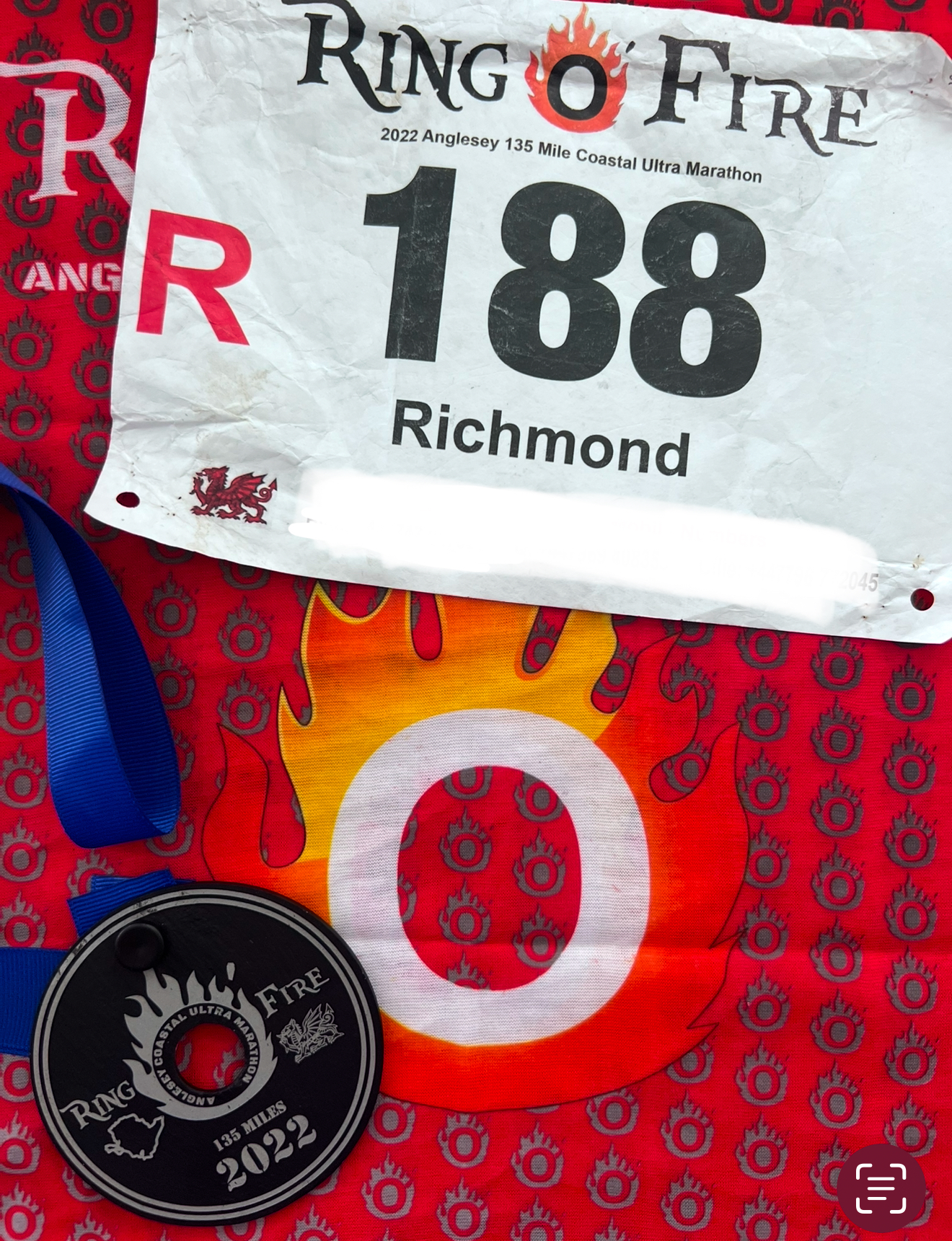
Ring O Fire ultra – why I finished

This time last week I was making the final preparations for the Ring O Fire (RoF) ultramarathon. Deemed to be one of the toughest ultras in the UK, RoF is a 135 miles of coastal path, travelled over three days.

I underestimated how difficult it was going to be. Despite the challenge of the distance, I did not consider the cut offs particularly seriously, nor the terrain. Now I know!

It was tough! The toughest of the 30 odd ultras that I have done for upandrun. But now, that makes it one of the most satisfying to have completed. In the end 96 people started RoF and 53 finished.

At the start

There are several reasons why I was able to finish. I will come to that shortly.

For two years I ran monthly ultras for Understand Pain, and called it upandrun. The purpose was and continues to be raising awareness of the global problem of chronic pain that affects millions of people (and their loved ones) and costs billions. The aim is to erase suffering.

I maintain that this enormous social problem, for it is embedded in a society, is largely due to the misunderstanding of pain.

What is pain? Can you answer that question? You know it hurts and what it can feel like from a personal perspective, but what actually is pain? This is a question that scientists and philosophers have been trying to answer. Now we have some really good ideas.

Are we there yet with the understanding? Absolutely not. But our role is to keep the momentum going and build onwards.

What about now? We can offer help, guidance, support and encouragement to people suffering chronic pain in many ways. Many are simple and low tech, meaning they can be used by many to help many. Pain Coaching is my way of helping.

And we really can help and make a difference. But it starts with the person understanding their pain. This means taking the knowledge and skilfully passing it on in such a way that the person can make sense of their experiences and see a way forward.

Again, we can help them by sharing practical ways of living best lives, building health, and dealing with challenging moments. All of these are skills that can be learned and honed.

The two years of ultras took their toll. I was not well organised with training, made many mistakes and didn’t adequately recover. Add in a few trips and falls, and I found myself accumulating significant aches and pains. I needed a break and a training programme. I needed a coach.

So I let things settle down, taking it much easier. And being much easier on myself. The influences on running had been all about constant pushing and pushing. Then I was introduced to the idea of happy running via my now coach, Damian Hall.

The Happy Runner is the book by David and Megan Roche. The concept and approach resonated with me. I wanted to enjoy running again instead of it being a chore. Becoming a happy runner was one of the key ingredients for success at RoF.

Back to the reasons why I finished.

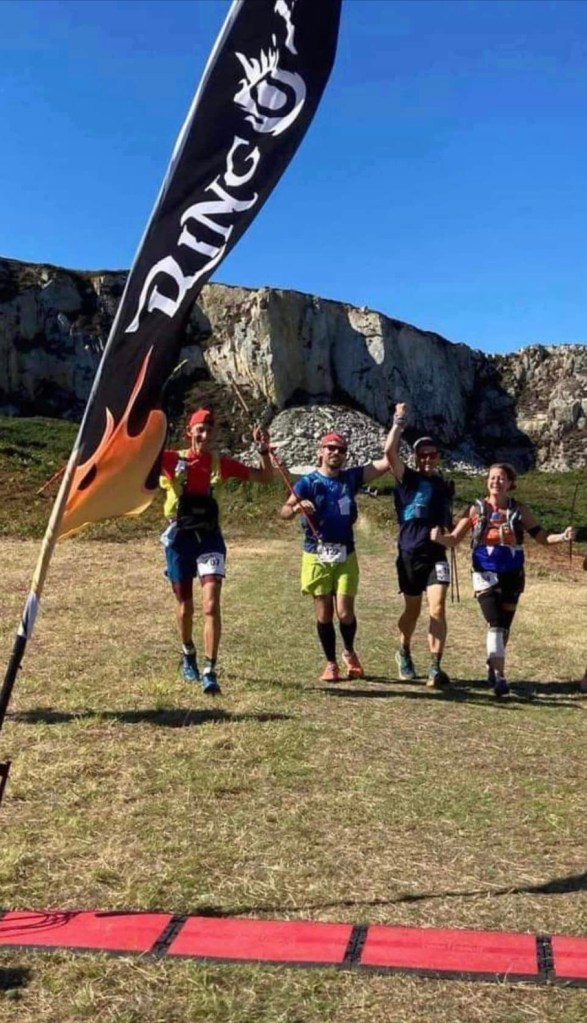
Finishing with John, Gavin & Lou (L to R – I am 2nd from R) after 135 miles

The two other main ingredients were my training programme and the people I ran with. There is also a dose of luck, which I believe we feed into with our own personal approach. So maybe it’s not luck after all, and certainly not pure luck.

I will not give you a detailed outline of my programme, designed by Damian. It was not stand alone from his encouragement either. Suffice to say, it was all about complete (and happy) preparation for the journey.

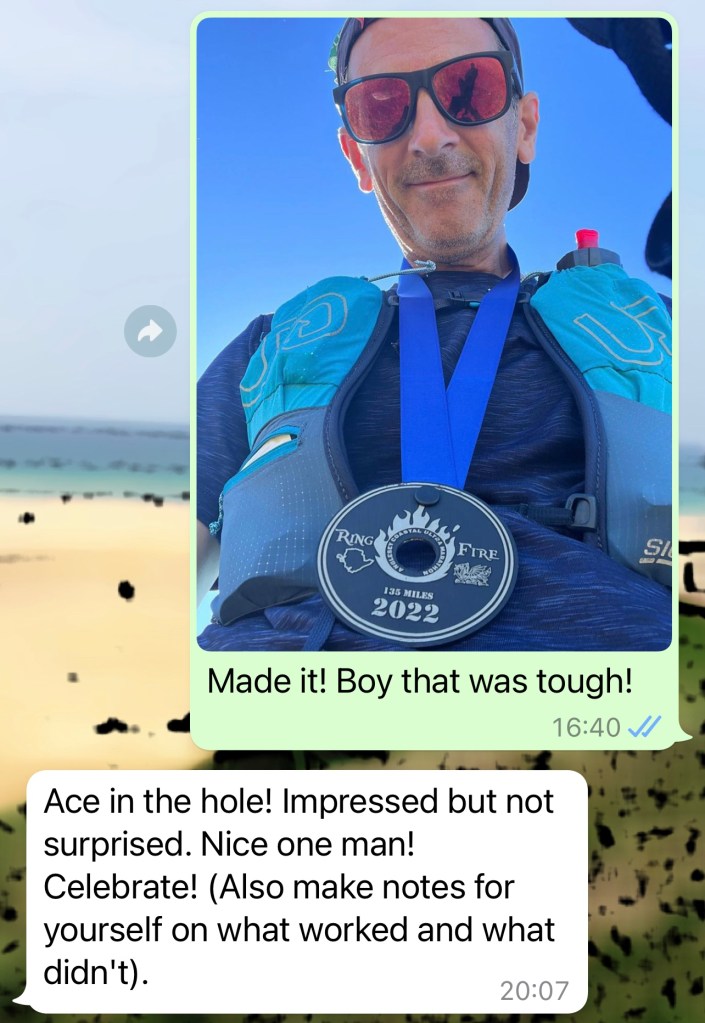
On completing RoF I sent Damo a message.

He replied, Impressed but not surprised. What a super encouraging response. And suggesting I make notes on how it went. Now that’s a great idea.

Because it’s all about learning. What did I learn? I’m sharing a few things here and maybe some more in weeks to come.

Now, the people. To me this is what really makes ultrarunning.

A few days before I did not know a single person. Now I have made connections that I hope will remain for life. Because of what we achieved together.

Togetherness and interbeing are insights I often work with people I see as a professional helper. Within these connections sit the richness of life. Sharing this experience makes it what it is; so special and so powerful.

For hours we trot along, sometimes talking, sometimes in silence. But together. You are backing someone and they you within just a few hours of meeting. And it is natural. This is what we are meant to do, not just in an ultramarathon, but in life.

The emotion on finishing was overwhelming. Because of the connections and the fact that we had done it together. I did not complete that course on my own. It was with superb people, four in particular: Helen, Lou, Hayley, John and Gavin.

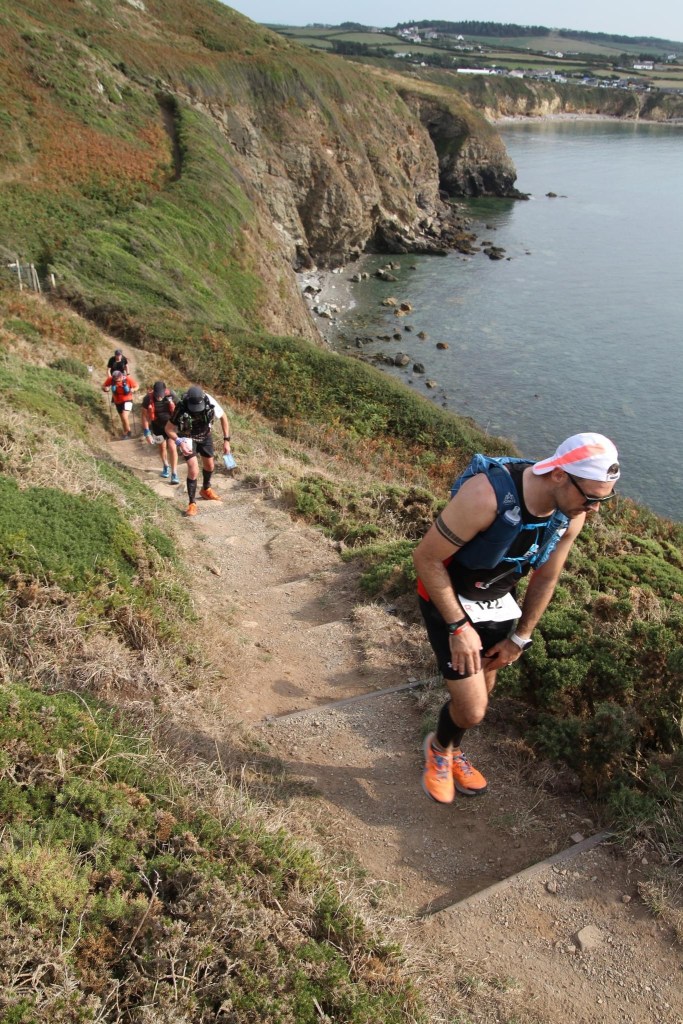
Photo: http://www.ringofire.co.uk

And the support people and all the other runners. Everyone played their part in creating the conditions for what was to happen.

Photo: http://www.ringofire.co.uk

And what happened, it was the only thing that could have happened.

Are these experiences life changing? Absolutely. But only because of the people and togetherness.

RS

upandrun ~ encouraging you to be active in your own way, and supporting The Green Runners (make your pledge!) and Medical Aid for Palestinians (MAP) (see future posts for my work with MAP that is coming up soon).

** If you have enjoyed this and want to keep up to date with Understand Pain and upandrun, please do subscribe.